

Best strategy board games for serious gamers in NZ 2026
Best overall: Everdell. Best for low-conflict engine building: Wingspan Revised Edition. Best for cooperative farming: Stardew Valley: The Board Game. This 2026 guide from Pop Stop compares strategy board games by the decisions you make, not just the theme on the box.
- Everdell is the best overall strategy board games pick for worker placement and card combinations.
- Wingspan Revised Edition suits engine-building fans who prefer less direct confrontation.
- Stardew Valley: The Board Game rewards shared planning rather than competitive scoring.
- Pop Stop is a New Zealand-owned retailer for fans shopping for board games and pop culture collectables.
Why this matters
Serious gaming does not have to mean a sprawling war game. A tight resource decision, a carefully timed card combination or a shared objective can give your group plenty to think about.
The real question is what kind of pressure you enjoy. Do you want opponents taking the action you needed, a personal engine that becomes more efficient, or a team scrambling to finish its objectives? This 2026 shortlist separates those experiences so you can choose a game your group will actually want to replay.
What makes the best strategy board games?
- Meaningful trade-offs: Taking one action should mean giving up another useful opportunity.
- Strategic development: Your early choices should shape your later turns, rather than disappear after a round.
- Interaction fit: Competition for shared spaces feels different from direct attacks or cooperative planning.
- Replay decisions: Changing cards, objectives or encounters should ask you to rethink your approach.
- Teaching burden: A game needs to suit the person explaining it as well as the people learning it.
- Theme fit: Farming, fantasy adventures and bird habitats attract different groups; none automatically makes a game deeper.
For a 2026 purchase, prioritise the first three criteria. A beautiful box cannot rescue a game whose central decisions your group dislikes.
Strategy board games at a glance
| Game | Best for | Standout feature | Key limitation |
|---|---|---|---|
| Everdell | Worker placement and card combinations | Building a woodland city while managing scarce actions | Shared card draws add uncertainty |
| Wingspan Revised Edition | Low-conflict engine building | Bird powers improve your habitat actions | Limited direct confrontation |
| Stardew Valley: The Board Game | Cooperative farming | Coordinating farm activities and shared goals | Random outcomes disrupt plans |
| D&D Tomb of Annihilation Adventure System Board Game (Premium Edition) | Dungeon adventures | Exploration, hero abilities and tactical encounters | Dice and encounters prevent deterministic planning |
| The Lord of the Rings The Board Game Anniversary Edition | Shared resource management | Cooperative progress against a common threat | Collective planning can let one voice dominate |
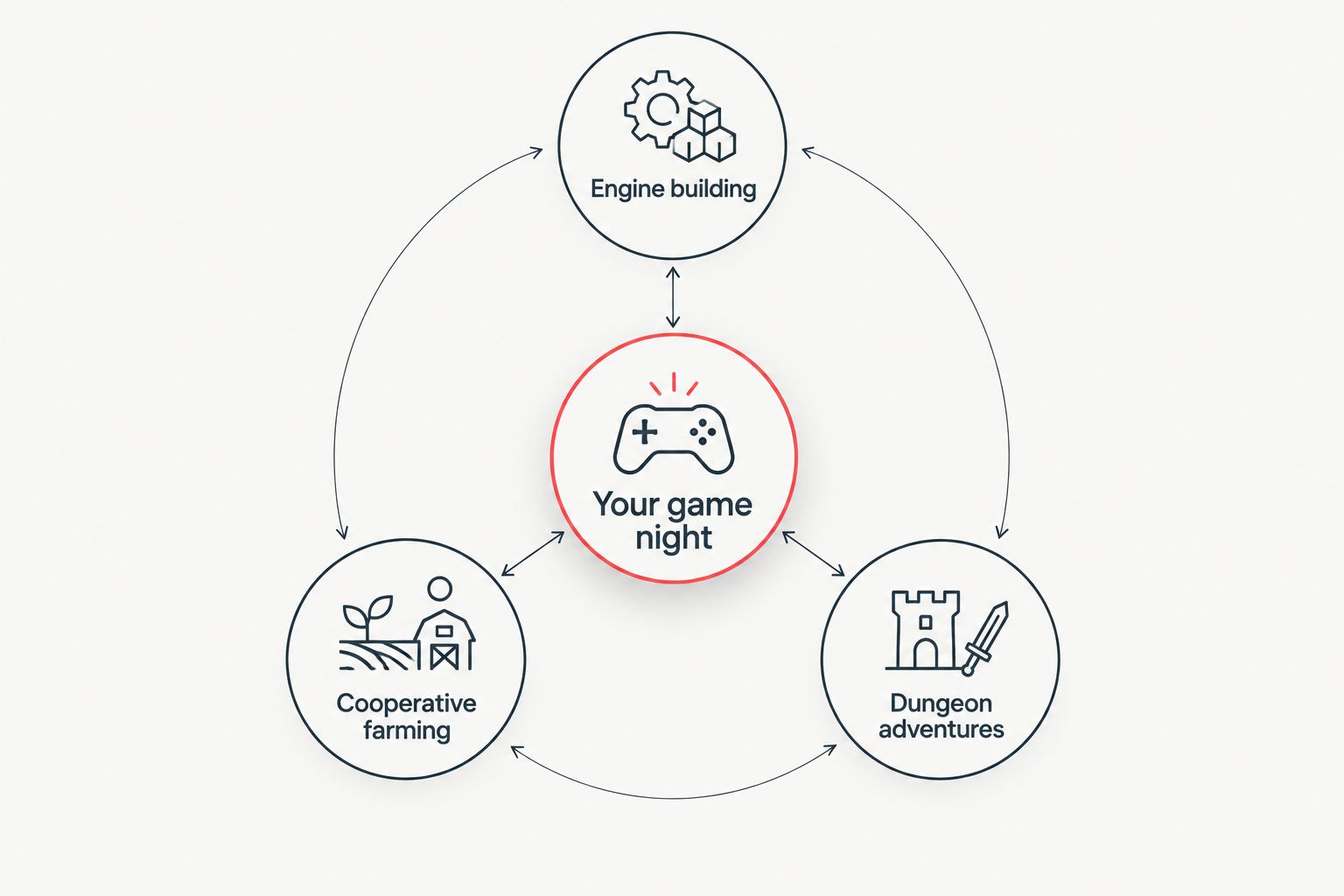
For your game night, start with the experience: engine building, cooperative farming or dungeon adventures. That choice matters more than whether everyone recognises the franchise.
1. Everdell: best strategy board game for worker placement
Everdell combines worker placement with a card-built woodland city. You gather resources, recruit critters and construct buildings, looking for combinations that make later actions more effective. The standard base game supports 1–4 players, with each city limited to 15 cards.
That city limit makes attractive cards compete for space. Your problem is not simply collecting more stuff; it is deciding which cards deserve a place in your scoring plan. Shared worker spaces add another layer because opponents can claim useful opportunities first.
Everdell pros:
- Worker placement and card combinations create connected decisions.
- The city limit rewards selective building rather than indiscriminate expansion.
- Shared spaces make opponent timing relevant.
Everdell cons:
- Card draws prevent complete control over your plan.
- New players need time to read cards and recognise combinations.
Best for: Players who want competitive planning without a game built around attacking each other.
Verdict: Buy Everdell as the default choice for this 2026 shortlist.
2. Wingspan Revised Edition: best for low-conflict engine building
Wingspan centres on birds placed in habitats that generate food, eggs and additional cards. Bird powers make those actions more productive as your board develops. You compete for points, but much of the satisfaction comes from making your own engine work.
Choose Wingspan Revised Edition when your group enjoys efficiency puzzles more than confrontation. Its bird theme does not make it a lightweight party game: card selection, resource requirements and action timing still demand attention. Read the edition details rather than assuming every Wingspan box contains the same material.
Wingspan Revised Edition pros:
- Habitat actions give your engine a clear structure.
- Bird powers create different combinations to explore.
- Limited direct aggression suits players who dislike attacks.
Wingspan Revised Edition cons:
- Random cards and food options constrain your choices.
- Players seeking constant opponent interference will want something sharper.
Best for: Engine-building fans who want competitive scoring with less friction across the table.
Verdict: Buy Wingspan Revised Edition for low-conflict strategy, not head-to-head combat.
3. Stardew Valley: The Board Game: best for cooperative farming
Stardew Valley: The Board Game turns the farming game's activities into a shared tabletop challenge. You coordinate farming, fishing, mining and other tasks while working towards collective objectives. Its calendar moves through 4 seasons, so your team cannot postpone every difficult decision.
The familiar setting is the hook; coordination is the substance. Players need to divide responsibilities and react when a planned activity does not deliver the result they wanted. Being a fan of the video game helps with the theme, but it does not replace learning the board game's rules.
Stardew Valley: The Board Game pros:
- Shared objectives give the whole table a common purpose.
- Different activities encourage players to divide responsibilities.
- Seasonal progression creates pressure to prioritise.
Stardew Valley: The Board Game cons:
- Random results can derail an otherwise sensible plan.
- The cooperative puzzle is not a substitute for competitive strategy.
Best for: Stardew fans who enjoy discussing decisions and solving a problem together.
Verdict: Buy Stardew Valley: The Board Game for cooperative planning; skip it if you want competitive scoring.
4. D&D Tomb of Annihilation: best for dungeon adventures
D&D Tomb of Annihilation Adventure System Board Game (Premium Edition) puts you in the role of a heroic adventurer with abilities, spells and magic weapons. Exploration and encounters make this a different proposition from building an economic engine.
The D&D Adventure System uses cooperative dungeon exploration, with tactical choices shaped by the heroes and dangers on the table. You are responding to threats rather than executing an uninterrupted scoring plan. That suits players who enjoy adventure stories emerging from uncertain encounters.
D&D Tomb of Annihilation pros:
- Hero abilities give players different tactical tools.
- Exploration provides a shared adventure rather than separate scoring puzzles.
- Fantasy encounters make the decisions feel connected to the setting.
D&D Tomb of Annihilation cons:
- Dice and encounters limit control over outcomes.
- Players seeking economic strategy should choose another game.
Best for: Fantasy fans who want cooperative dungeon tactics rather than worker placement.
Verdict: Buy D&D Tomb of Annihilation for adventure-focused strategy.
5. The Lord of the Rings: best for shared resource management
The Lord of the Rings The Board Game Anniversary Edition is a cooperative tabletop retelling of Tolkien's trilogy. Players manage cards and resources while progressing through scenarios against a shared threat. It is not a competitive army-control game.
Its strategic appeal is deciding when to contribute resources and when to preserve them. The group needs a plan, but every player still needs a voice. If one person dictates all the moves, the cooperative experience loses its point.
The Lord of the Rings pros:
- Shared danger gives resource decisions a common purpose.
- Card management rewards thinking beyond the current turn.
- The journey offers a clear thematic reason to cooperate.
The Lord of the Rings cons:
- Group discussion can become dominated by one player.
- Players wanting competitive battles should choose a different design.
Best for: Tolkien fans who enjoy collective planning and careful resource use.
Verdict: Buy The Lord of the Rings for cooperation, not conquest.
The two fantasy picks below suit different groups: dungeon encounters for adventure fans, or shared resource planning for a fellowship. Neither replaces the competitive engine-building options above.


How these games rank
This Pop Stop strategy board games guide ranks decision fit, not sales, review scores or claimed testing results. Everdell takes the default slot because worker placement, resource management and card combinations give competitive players several connected problems to solve.
The other picks serve distinct preferences. Wingspan favours personal engine development; Stardew Valley favours shared task planning; D&D favours encounters; The Lord of the Rings favours collective resource decisions. A different preferred experience changes your best choice.
Which strategy board game should you choose?
Choose Everdell if you are undecided. It is the strongest default here for a group seeking competitive strategy through resource choices and card combinations.
For your 2026 game nights, choose Wingspan Revised Edition when direct conflict turns people off. Choose Stardew Valley: The Board Game when everyone wants to win together. Choose D&D Tomb of Annihilation for dungeon encounters, or The Lord of the Rings for cooperative card and resource management.
FAQ
What's the best strategy board game for serious gamers in NZ?
Everdell is the best overall pick in this shortlist for competitive worker placement and card combinations. Choose another option when your group prefers cooperation or dungeon adventures.
Is Everdell better than Wingspan?
Everdell is the better fit for shared worker-space competition; Wingspan Revised Edition is the better fit for low-conflict engine building. Both involve card combinations, but the interaction feels different.
Can you play Everdell with two players?
Yes, the standard Everdell base game supports two players within its 1–4 player range. Its worker placement and city-building decisions still form the core experience.
Is Stardew Valley: The Board Game competitive?
No, Stardew Valley: The Board Game is cooperative. Players coordinate activities and work towards shared objectives rather than compete for individual victory.
Are D&D board games the same as the D&D role-playing game?
No, D&D Tomb of Annihilation Adventure System Board Game is a board game with its own rules and encounters. It is a different format from a Dungeon Master-led role-playing campaign.
Is The Lord of the Rings Anniversary Edition a war game?
No, The Lord of the Rings The Board Game Anniversary Edition is a cooperative game about progressing against a shared threat. It is not a competitive army-control game.
What should I check before choosing a strategy board game?
Check the exact edition, player range and whether the game is competitive or cooperative. Then match its central decisions to what your group enjoys: worker placement, engine building, resource management or tactical encounters.
One last thing
Ask your group what kind of losing they can enjoy. Missing a shared objective, being denied a worker space and watching an opponent's engine outscore yours create different reactions. That answer is more useful than choosing whichever box looks most epic.
Pop Stop sells board games alongside pop culture collectables, but fandom is only the starting point. Choose the decisions you want to make repeatedly.

