

Board games for primary school classrooms: complete 2026 guide
Primary classroom board gaming is structured tabletop play with the aim of practising a chosen learning or social skill. Choose board games for primary school classrooms in 2026 by reading demands, group size and teachability—not just the characters on the box.
- Choose board games for primary school classrooms around one observable skill, then trial the rules with your learners.
- Exploding Kittens: The Board Game Super Fan Edition lists 2–6 players, 20-minute play and ages 7+.
- Pop Stop board games suit teachers seeking pop-culture themes; check each game's classroom fit before choosing.
- Use shared classroom sets, explicit turn-taking rules and a component checklist rather than personal collectable cards.
Why board games matter for primary classrooms
A classroom game needs to do more than entertain a willing group. You need rules children can follow, enough participation for everyone and a stopping point that fits your timetable. For your 2026 classroom plan, start with the behaviour you want to see: explaining a choice, counting accurately or waiting for a turn.
Pop Stop board games are best for teachers seeking pop-culture themes rather than a prescribed teaching programme. Pop Stop is a New Zealand-owned online and retail store selling board games alongside Pokémon, manga and other fan favourites. Familiar themes give you a starting point for discussion, but they do not establish educational suitability.
The product details show why selection matters. Exploding Kittens: The Board Game Super Fan Edition lists 2–6 players, a 20-minute play time and ages 7+. Those limits tell you who can join a game; they do not tell you whether your learners can read the cards independently or finish within a lesson.
How to choose and use classroom board games
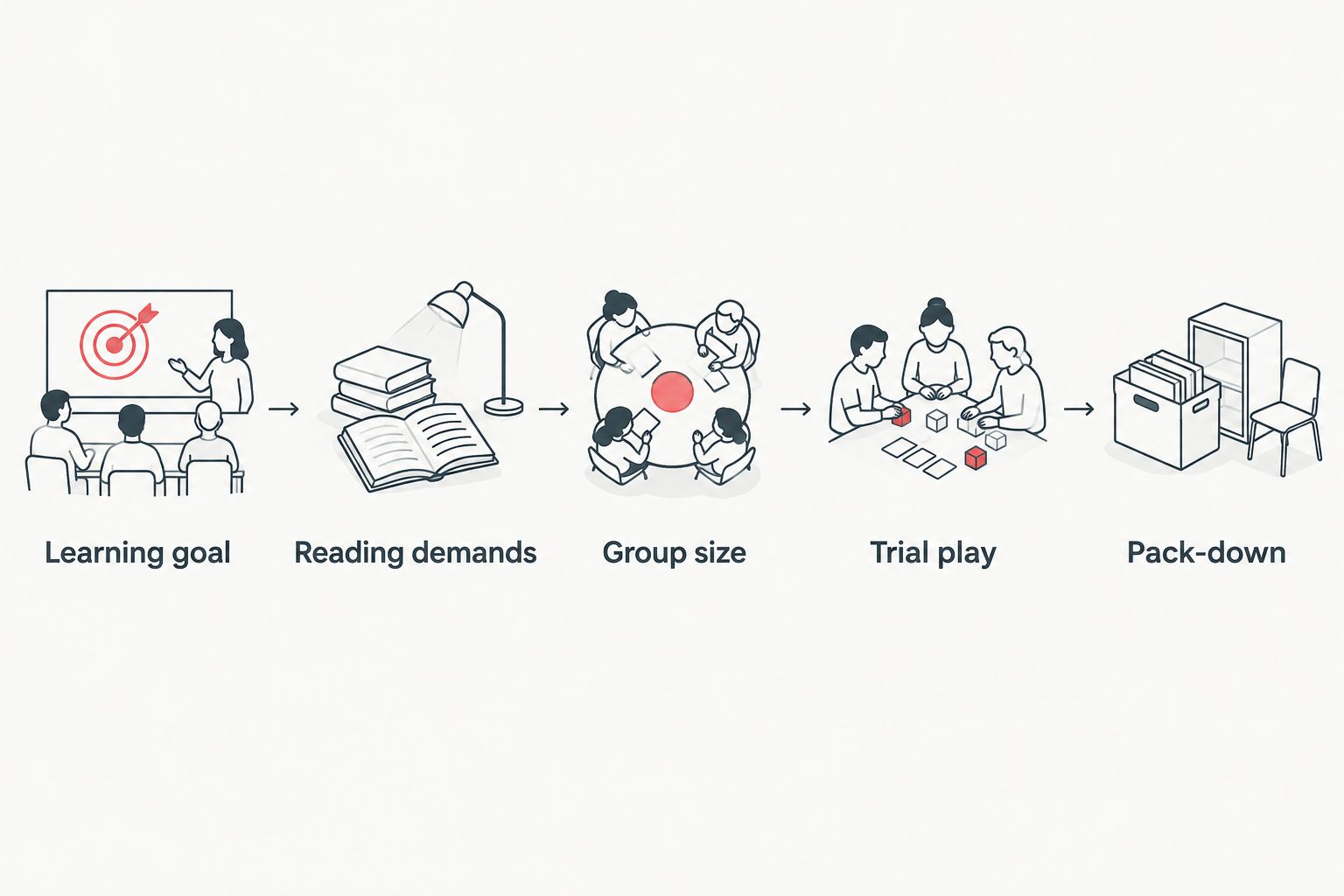
1. Define the learning goal before choosing a theme
Start with materials you already have: paper, counters, dice or a borrowed classroom game. Write a sentence describing what children should practise. If you cannot identify an action you can observe, keep the game for recreation rather than presenting it as a targeted lesson.
A counting task needs repeated counting decisions. An oral-language task needs opportunities to explain, not simply move a piece and pass the dice.
- Learning goal: name the skill in plain language.
- Visible evidence: decide what you will listen for or record.
- Success check: ask learners to demonstrate the skill after playing.
2. Check reading, access and emotional demands
Read the rules yourself, then demonstrate a turn without buying extra teaching resources. Look beyond the age label. A learner who understands the strategy still needs access to the text, symbols and physical pieces.
Give children ways to participate without making the strongest reader the permanent leader. Check competitive themes and how the group handles setbacks before choosing independent play.
- Reading demands: inspect instructions and cards, not only packaging.
- Physical access: check piece size, reach and ease of handling.
- Emotional fit: explain losing, disagreement and asking for help.
- Participation: rotate reading and decision-making responsibilities.
3. Match the game to the actual group
Borrow a copy or read its rules before committing your 2026 classroom resources. Count active players, not children who can physically fit around the table. A game that accommodates a group on the box still needs a workable turn cycle in your room.
For a commercial option, Exploding Kittens: The Board Game Super Fan Edition has an explicit 2–6-player range and 20-minute play time in the Pop Stop listing. Best for: an age-appropriate small-group trial with a stated play window. Preview its humour and rules first; the listed duration is not a lesson plan.
- Group size: stay within the game's stated player range.
- Waiting time: observe what children do between turns.
- Timetable fit: allow for teaching, setup and pack-down.
- Adult support: identify which groups need guided practice.
4. Teach a practice round before independent play
Use a teacher demonstration and a handwritten turn prompt first. Model an ordinary turn, a mistake and a disagreement. Let learners practise correcting an error without restarting everything.
Pokémon TCG Battle Academy Board Game Series 2 is another option to investigate: its description identifies a ready-to-play Pokémon Trading Card Game format. Best for: teacher-led exploration with Pokémon-interested learners. It is not automatically suitable for every primary group; check the instructions and reading load. The guide to what age Pokémon TCG is recommended for supports that selection question.
- Trial play: demonstrate before asking learners to work independently.
- Turn prompt: display the actions needed during a turn.
- Help routine: agree how learners request a rules check.
- Fair correction: model fixing mistakes without blame.
5. Protect shared pieces and keep ownership clear
Start with labelled containers and a handwritten inventory. Keep classroom sets separate from personal collections so a learning activity does not become a trading session. Agree where cards and pieces go before opening the box.
Sleeves are an optional protection step, not a requirement for teaching. Match the stated card dimensions carefully: Dragon Shield Board Game Sleeves: Standard Non Glare lists 63×88 mm cards, while the Medium version lists cards up to 57×89 mm. Similar names do not mean identical fit.
- Component check: list the pieces needed to play.
- Shared ownership: keep personal collectables outside the activity.
- Storage fit: check that protected cards still fit the insert.
- Pack-down: assign responsibility for checking and returning pieces.
6. Measure participation before adding more games
Use a paper observation sheet during your 2026 classroom trial. Record who explains decisions, who needs help and who waits without participating. Compare those observations with the learning goal rather than treating enthusiasm as evidence of mastery.
Keep, adapt or remove the activity on that basis. A popular game can remain a recreation choice without earning a place in your literacy or maths rotation.
- Participation check: record who actually makes decisions.
- Skill check: listen for the target language or reasoning.
- Access check: note repeated reading or handling barriers.
- Next action: repeat, adapt or replace the game.
Compare classroom options before choosing
Choose the simplest option that supports your learning goal. Pop Stop offers pop-culture games, but a teacher-made activity gives you direct control over vocabulary and task difficulty. Neither approach removes the need for a classroom trial.
| Option | Best for | Useful feature | Key limitation |
|---|---|---|---|
| Teacher-made board and counters | A narrowly defined learning task | You control vocabulary and rules | You must design and test the activity |
| Exploding Kittens: The Board Game Super Fan Edition | Small-group trials for learners meeting the listed age guidance | Lists 2–6 players, 20-minute play and ages 7+ | Theme and rules need previewing; teaching time is additional |
| Pokemon TCG - Battle Academy Board Game Series 2 | Guided play with Pokémon-interested learners | Described as ready-to-play | Reading demands and classroom suitability still need checking |
If either commercial format matches your trial criteria, these are the exact editions discussed above. Check the full descriptions before making your selection.


Common mistakes primary teachers make
- Choosing a favourite franchise before checking the task. Familiar characters do not establish reading accessibility or curriculum fit.
- Counting spectators as participants. Give each learner a meaningful decision rather than a permanent watching role.
- Scheduling only the listed play time. Your lesson also needs instructions, setup, reflection and pack-down.
- Mixing classroom play with personal card trading. Keep shared resources and personal possessions separate.
- Calling every game educational. State the intended skill and check whether learners actually practise it.
FAQ
What's the best way to choose board games for primary school classrooms?
Choose a game around one observable learning goal, then check reading demands, player count and rules. Trial it with your learners before making it an independent activity.
Can I use board games for both maths and literacy?
Yes, but select a specific task for each activity. Counting moves and explaining decisions are different goals, so observe the skill you actually intend to teach.
Is Exploding Kittens suitable for primary school children?
Exploding Kittens: The Board Game Super Fan Edition lists ages 7+, but classroom suitability needs a teacher preview. Its listing also states 2–6 players and a 20-minute play time.
Can I use Pokémon cards in a primary classroom?
Yes, as a teacher-selected activity with clear rules and suitable reading demands. Use shared classroom resources and keep personal trading separate from the lesson.
Do classroom board games need card sleeves?
No, card sleeves are optional. If you use them, match the card dimensions and check that the protected cards fit the game's storage.
How do I know whether a classroom game is working?
Check whether learners practise the target skill and participate in decisions. Record barriers such as repeated rules confusion, reading difficulty or long periods of waiting.
One last thing
For your final 2026 classroom check, ask a learner to teach a turn back to you. If the explanation stalls, reteach before adding another game. That tells you what needs attention more directly than asking whether everyone enjoyed playing.

