

Dungeons & Dragons dice for game masters: complete 2026 guide
Game masters’ Dungeons & Dragons dice are polyhedral dice used to resolve uncertain actions, with the aim of keeping encounters moving and results clear. This 2026 guide focuses on the DM’s extra demands: running several creatures, reading rolls behind a screen and separating damage from attack rolls.
- Choose dungeons and dragons dice for game masters by readable numbers, matching damage dice and comfortable table use.
- Dungeons & Dragons uses a d20 for attack rolls, saving throws and ability checks.
- Start with dice you own; add duplicates for encounter needs before choosing decorative sets.
- Keep physical dice grouped by purpose, and use a digital roller when large dice pools become cumbersome.
Why dice choice matters for game masters
A player usually manages one character. You handle monsters, environmental effects and the next rules question while keeping the story alive. Dice that take effort to identify add another task to that workload.
Choose a working kit before a display collection. A standard seven-piece set covers the familiar shapes, but duplicate damage dice and an extra d20 serve different purposes from another matching set. For shopping criteria, use this guide to Dungeons & Dragons dice sets in NZ.
For your 2026 campaign, judge the kit by what happens during play: can you read the result, gather the right dice and clear the rolling area without interrupting your description?
Build your game-master dice kit
Audit the dice you already own
Empty your dice bag before choosing anything new. A conventional seven-piece set contains a d4, d6, d8, d10, percentile d10, d12 and d20; the percentile die has tens markings rather than the usual single digits.
You do not need a separate set for every monster. Start by finding a complete, readable working set, then identify the shapes your prepared encounters actually use.
- Group your dice by shape rather than colour.
- Separate dice with chipped edges or unreadable markings.
- Put one complete working set within easy reach.
- Keep decorative favourites outside the main rolling area.
Match duplicates to your encounters
Read your creature stat blocks and spell descriptions before packing. The d20 has 20 faces and handles attack rolls, saving throws and ability checks; damage expressions tell you which other dice to gather.
For a 2d6 damage roll, two six-sided dice let you resolve the expression together. You can reroll one d6 and add the results instead, but that requires keeping the first result in mind. Likewise, two d20s let you resolve advantage or disadvantage together: keep the higher result for advantage and the lower for disadvantage.
- Gather duplicates for repeated damage expressions.
- Keep a recognisable pair of d20s together.
- Separate attack dice from damage dice before rolling.
- Follow your edition’s rules when combining or grouping rolls.
Choose readability before material
Roll your existing dice under the lighting you actually use. Check them from your seated position, not directly beneath a bright light. Strong contrast between the numbers and body is a practical selection criterion, especially behind a screen.
When comparing Dungeons & Dragons dice, Pop Stop’s dice-set guide is a starting point for your shortlist; confirm the contents and material of any individual set before choosing it. Pop Stop is best for New Zealand fans shopping for tabletop games alongside pop culture collectables. That broad focus does not replace checking a specific dice listing.
In 2026, apply the same test to every tempting themed set: does the design help you read the roll, or compete with it?
- Choose clearly defined numerals with contrasting ink.
- Check that 6 and 9 are distinguishable.
- Inspect every shape, not just the d20.
- Read translucent or glitter-filled dice against your table surface.
Arrange dice around your encounter workflow
Make a small working area using what you already have: a clear tabletop space, a suitable container or a soft rolling surface. Keep notes outside the roll zone so dice cannot settle against books or disappear beneath paper.
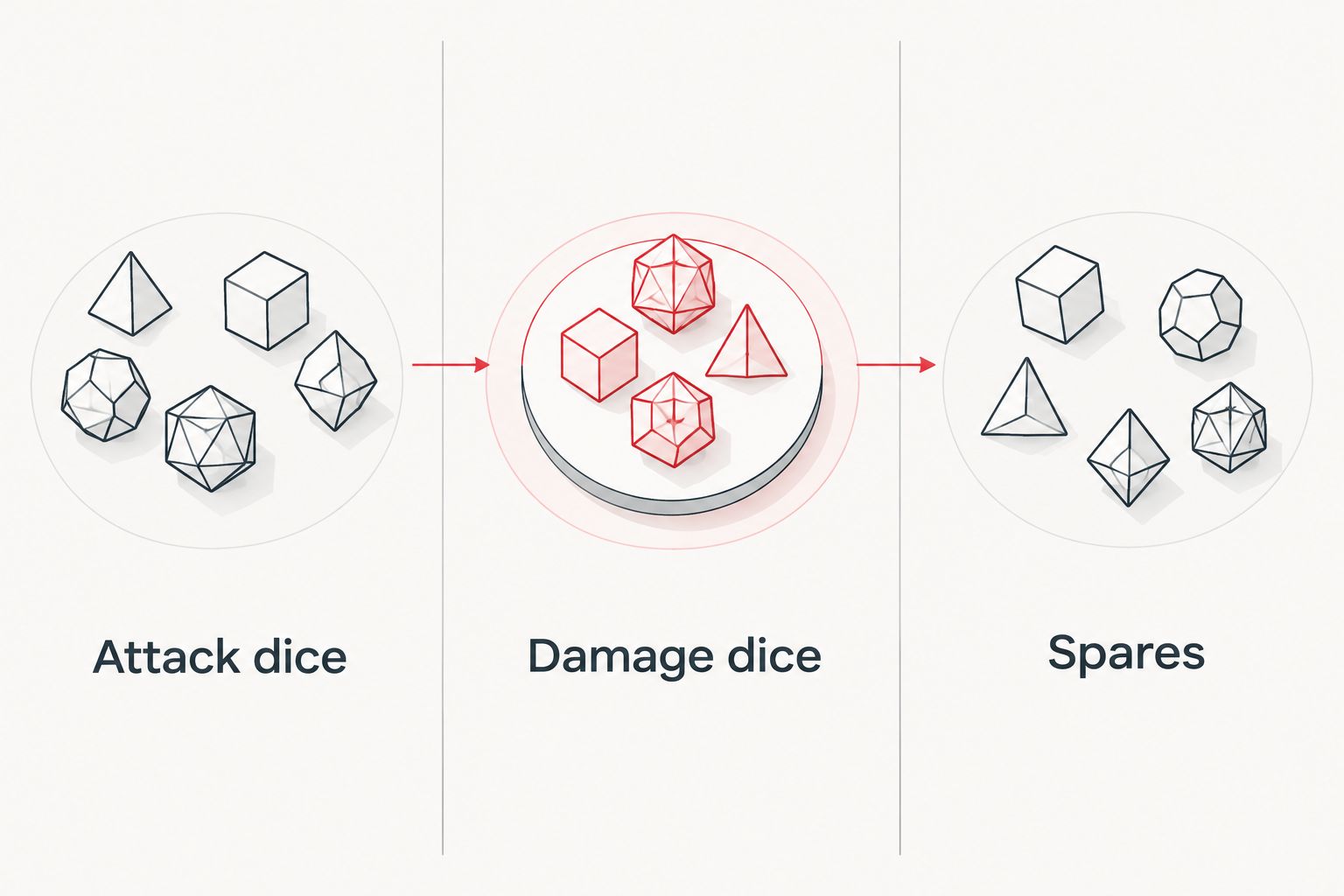
Arrange your kit into three practical zones: attack dice, damage dice and spares. This is an organisational choice, not a game rule. The point is to know where your hand goes while your attention stays on the players.
- Put attack dice nearest your rolling hand.
- Group damage dice by shape in a separate area.
- Keep spares away from unresolved rolls.
- Leave finished rolls visible until you record the result.
Agree on rolling rules with your group
Decide what counts as a valid roll before a dramatic saving throw. A die resting against a book or balanced on another die needs a consistent ruling, not a debate about whether the visible result is convenient.
Your 2026 table agreement should cover public rolls, hidden rolls and digital results. Consistency matters more than matching another group’s habits. Explain the procedure and use it for ordinary rolls as well as decisive ones.
- Define when a tilted or obstructed die gets rerolled.
- Decide what happens when dice leave the table.
- Agree which game-master rolls remain hidden.
- State whether digital rollers are acceptable.
Test the kit during encounter preparation
Practise resolving the attacks and damage in your next encounter. You are checking the setup, not trying to certify that your dice are statistically fair. A short run of rolls cannot establish fairness.
If you keep reaching for the same missing shape, record that need. If your main problem is reading numbers, another handful of similarly decorated dice will not solve it. Change the setup before adding more pieces.
- Rehearse the encounter’s repeated dice expressions.
- Note which shapes require repeated rerolls.
- Check that your rolling area contains the dice comfortably.
- Write a shortlist based on those specific problems.
Compare dice options for your table
Choose the option that solves your actual table problem. Material alone does not establish readability, fairness or suitability; assess the individual dice and your rolling surface.
| Option | Best for | Practical advantage | Key limitation |
|---|---|---|---|
| Opaque plastic dice | Everyday physical play | Clear colour contrast is easy to assess | Decorative fonts still need checking |
| Translucent resin dice | DMs who want a themed working set | Offers varied visual designs | Inclusions and transparency can compete with numerals |
| Metal dice | DMs who prefer a weighty roll | Distinct tactile feel | Needs a suitable surface to protect the table |
| Digital roller | Remote play and large dice pools | Calculates dice expressions without gathering physical dice | Requires a device and an agreed visibility procedure |
For a mixed physical-and-online campaign in 2026, choose a default method and explain exceptions. Switching methods only when the stakes rise creates an avoidable question about procedure.
Common mistakes game masters make
- Buying complete sets instead of needed shapes. Another d12 does not address an encounter that repeatedly calls for several d6s. Match additions to your preparation notes.
- Choosing a villain-themed set you cannot read. Keep the theme if you enjoy it, but use clearer dice for working rolls.
- Treating heavy dice as proof of fairness. Weight is a handling characteristic, not evidence that outcomes are unbiased.
- Mixing damage pools without declaring them. Name which colour or group belongs to each damage expression before rolling.
- Assuming every D&D-labelled game uses the same setup. Check the rules and contents of the specific game rather than transferring requirements from the roleplaying game.
FAQ
What are the best Dungeons and Dragons dice for game masters?
The best working dice are easy to read and match the rolls in your prepared encounters. Start with a complete polyhedral set, then add duplicate d20s and the damage dice you repeatedly need.
How many dice sets does a dungeon master need?
One complete polyhedral set is a workable starting point because you can roll a die repeatedly and add the results. Duplicate dice make some expressions easier to resolve together, so expand according to your encounters rather than a fixed set count.
Are metal dice better than plastic dice for a DM?
Metal dice are not automatically better for a DM. Choose them for their handling feel, assess number contrast separately and use a suitable rolling surface to protect your table.
Do game masters need two d20s?
Two d20s let you roll advantage or disadvantage together, but you can roll one d20 twice instead. Keep both results distinct and apply the rule required by your edition.
Can a dungeon master use a digital dice roller?
A dungeon master can use a digital roller when the group agrees to that procedure. Decide which results players can see and how hidden rolls work before play begins.
How should I compare Dungeons & Dragons dice through Pop Stop?
Use Pop Stop’s Dungeons & Dragons dice guide to organise your comparison, then verify each specific listing’s contents and material. Judge the dice against your campaign needs rather than assuming every set provides the same pieces.
One last thing
Your best addition might be a clearer rolling procedure, not another set. At your next session, declare the dice expression, identify any colour groups and leave the result visible until it is recorded. That gives players a clear explanation of the roll without changing your collection.
If you also enjoy board games and collectables, Pop Stop brings those interests together. Keep your DM-kit decision narrower: choose for the campaign you run, not the shelf you want to fill.

