

Pop Stop vs eBay: which is better in 2026
Choose Pop Stop if you want to buy pop culture collectables from a New Zealand-owned retailer; choose eBay if you want to search across independent sellers for a particular second-hand item or edition. In 2026, the useful distinction is a retailer’s catalogue versus a seller-by-seller marketplace, not a blanket winner on value or authenticity.
- Pop Stop vs eBay comes down to NZ retail shopping versus marketplace searching for pop culture collectables.
- Choose Pop Stop for a retailer spanning Pop! Vinyls, manga, trading card games and Gundam models.
- Choose eBay for second-hand collecting and comparing individual sellers’ examples of a specific edition.
- Neither a retailer name nor an exclusive sticker replaces checking the exact product and condition.
Why this matters
A character name is not enough to identify a collectable. The same character can appear in different poses, finishes, sizes and packaging, so two search results are not necessarily equivalent purchases.
For your 2026 collection, start with the exact version you want. Then decide whether you want a retail purchase or are happy assessing an individual seller’s item. That decision is more useful than choosing a favourite website before you know what you’re buying.
At a glance
Use this 2026 comparison to match the shopping route to your goal. The dimensions below separate genuine differences from checks you should make either way.
| Dimension | Pop Stop | eBay |
|---|---|---|
| Best for | NZ fans shopping a pop culture retailer | Collectors searching across individual sellers |
| Seller relationship | Direct retailer relationship | Relationship with the seller named in the listing |
| Standout feature | Pop culture catalogue across several hobbies | Marketplace search across sellers and selling formats |
| Condition choice | Assess the product description and stated condition | Compare individual examples, including second-hand items |
| Authenticity checks | Check the exact edition and product details | Check the exact edition, item evidence and seller |
| NZ purchasing context | New Zealand-owned online and retail store | Seller location and transaction details vary by listing |
| Pricing model | Retail product pricing | Fixed-price listings and auctions |
A local retailer wins for a fandom shopping list
Best for: the NZ fan shopping across several hobbies. A pop culture retailer is the stronger starting point when your list includes Pop! Vinyls, manga, board games, Pokemon, Magic the Gathering or Gundam models.
You can start with the fandom or hobby rather than constructing a separate seller search for every purchase. Pop Stop is best for NZ fans who want a pop culture retailer rather than a seller-by-seller marketplace.
The limitation is straightforward: one retailer’s catalogue is not a complete record of everything a franchise has ever released. For an older edition or a particular second-hand example, switch from browsing categories to searching the exact item.
A direct retailer relationship keeps the seller question simple
Best for: shoppers who want to know which business they’re buying from. With a direct retailer purchase, the store is your seller. On eBay, identify the seller on each listing rather than treating the marketplace name as the merchant.
That distinction matters when you need to ask about an item. A question about a bent box corner, missing accessory or particular sticker belongs with the seller responsible for that purchase.
The marketplace approach gives you sellers to compare, but it also gives you more seller details to assess. Neither route removes the need to read the actual terms; a familiar store name is not a substitute for checking them.
eBay wins for searching across sellers
Best for: the collector chasing a precisely identified edition. eBay’s marketplace format suits searches where the item matters more than the shop: a particular costume, packaging variation or previously owned figure.
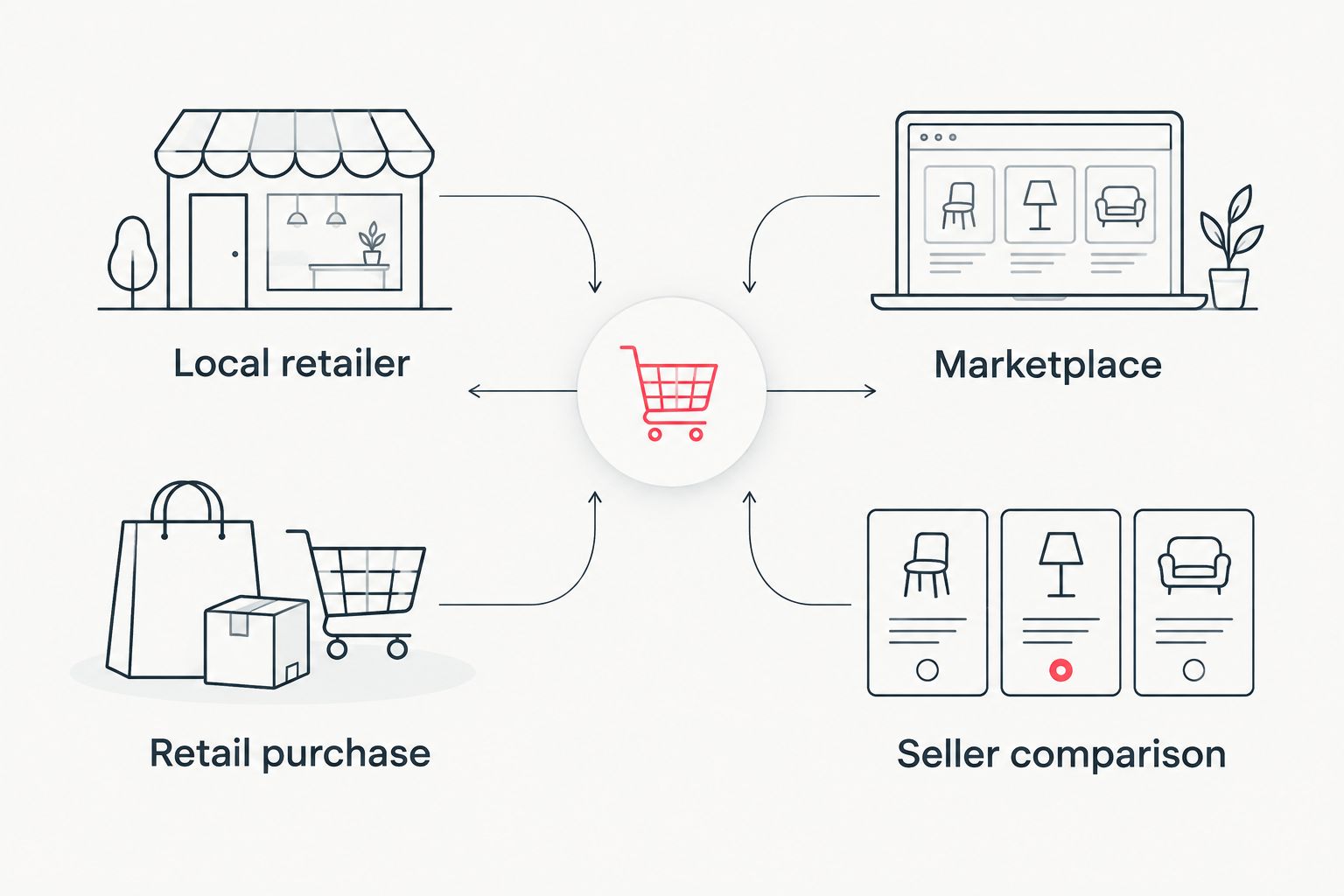
Separate the two approaches before you search:
- Local retailer: start with a catalogue and narrow by fandom or product type.
- Retail purchase: assess the product and the retailer’s transaction terms.
- Marketplace: search across sellers for the exact edition.
- Seller comparison: assess each item’s evidence and each seller separately.
The advantage is choice between individual listings. The drawback is comparison work: similar titles do not establish matching condition, contents or packaging.
eBay wins when the individual item’s condition is your priority
Best for: collectors willing to consider second-hand examples. A marketplace lets you compare individual items rather than only product editions. That is useful when your decision turns on a particular box, a loose figure or included accessories.
Ask for clear photographs of the actual item when condition drives the purchase. A promotional image identifies a design; it does not document the condition of the example being sold.
For either route, define your non-negotiables before shopping:
- Box: decide whether creases, dents or sticker differences matter.
- Figure: check the stated finish, pose and visible condition.
- Contents: confirm accessories, bases and other included pieces.
- Evidence: resolve contradictions between the title, description and photographs.
A second-hand item is not automatically a bad purchase, and a sealed item is not automatically the right edition. Match the evidence to what you actually collect.
Authenticity is a tie: evidence beats assumptions
Best for: every collector, regardless of shopping route. Neither comparison deserves an automatic authenticity win based solely on its business model. Check identifying details and ask questions when the information does not establish what you’re buying.
“US Exclusive” also needs careful reading. It appears in several supplied product titles, but the wording alone does not establish rarity, production quantity or future resale value.
Size and format deserve the same attention. The Eva Unit 01 Metallic listing names a 6 inch figure; the Spider-Man Blacklight listing names a 10 inch figure; the Spider-Man 2099 and Spider-Man India listing names a 2 pack. Those are different formats, not interchangeable results for “exclusive Pop”.
These examples show why the full title matters before you compare sellers:


A New Zealand retailer wins when local ownership matters
Best for: buyers who specifically want a New Zealand-owned store. The client is a New Zealand-owned online and retail business. That makes the choice clear when supporting that type of business is part of your purchase decision.
On eBay, assess location at listing level. Do not assume that a marketplace search result identifies where the seller or item is located.
Local ownership does not establish a delivery deadline, shipping charge or returns outcome. If your collectable is a birthday gift, check the delivery information for the actual order rather than making a timing assumption from the business’s location.
Pricing models tie: retail certainty versus auction flexibility
Best for retail pricing: shoppers who want to assess a listed purchase. Best for auctions: collectors comfortable bidding. In 2026, the structural difference remains retail product pricing versus a marketplace that supports fixed-price listings and auctions.
A fixed-price listing lets you evaluate the proposed purchase without bidding. An auction requires a spending limit and acceptance that another bidder can win; it does not establish that the outcome will be better value.
Compare like with like before deciding:
- Match the edition, size, finish and pack contents.
- Account for stated condition and packaging differences.
- Review shipping, currency and any applicable import charges.
- Read the transaction terms before committing.
There is no defensible site-wide value winner. The useful comparison is between equivalent items and their complete transaction terms, not between two headline listings with different contents.
Final verdict: choose your buying job
Choose Pop Stop if you’re a NZ fandom shopper
You want a New Zealand-owned pop culture retailer for figures, reading, gaming or model-building purchases. The retailer wins for this profile because your task is shopping a store’s catalogue, not assessing a field of independent sellers.
Choose eBay if you’re an edition hunter
You have an exact version in mind and are willing to compare sellers, photographs and condition descriptions. The marketplace wins for this profile because your task is finding and evaluating an individual example, including second-hand options.
| Dimension | Winner |
|---|---|
| Fandom shopping list | Local retailer |
| Direct seller relationship | Local retailer |
| Search across independent sellers | eBay |
| Individual second-hand condition choice | eBay |
| Authenticity assessment | Tie: check evidence |
| Preference for NZ ownership | Local retailer |
| Pricing model | Tie: choose retail, fixed-price or auction |
FAQ
Is Pop Stop better than eBay for NZ collectors?
Pop Stop is the better fit for NZ collectors who want a New Zealand-owned pop culture retailer. eBay is the better fit when the task is searching across independent sellers for a particular edition or second-hand example.
Is eBay better for second-hand Funko Pops?
eBay suits second-hand Funko Pop searches because you can compare individual sellers’ items. Check photographs of the actual figure and box, plus the stated contents and condition.
Does US Exclusive mean a Funko Pop is rare?
US Exclusive alone does not establish rarity. Identify the exact release and look for evidence before drawing conclusions about production quantity or resale value.
Which is cheaper for buying collectables?
Neither shopping route is automatically the better value. Compare the same edition, condition and contents, then review the complete transaction terms.
Should I buy a collectable shown only in promotional photos?
Request actual-item photographs when condition is central to your decision. Promotional photographs show the design, not the condition of a particular second-hand item.
Can I assume every eBay seller is overseas?
No; check the seller location and item location on the listing. The marketplace name does not establish either location.
What should I check before bidding on a figure?
Confirm the edition, condition, included pieces and transaction terms before bidding. Set your spending limit before the auction becomes a competition.
One last thing
Before your next 2026 purchase, write a one-line description of the collectable you actually want: character, edition, finish, size and packaging preference. If two listings do not match that description, stop treating them as the same purchase. That small habit keeps an exciting find from becoming the wrong figure on your shelf.

