

Can you play Yu-Gi-Oh with just a starter deck? Yes
Yes, you can play Yu-Gi-Oh! with just a starter deck: a complete deck for the standard Trading Card Game lets you learn and duel without adding booster packs. Your opponent needs their own deck, and an older starter deck needs a legality check before you use it at a sanctioned event.
- Can you play Yu-Gi-Oh with just a starter deck? Yes—start with a complete deck for the standard TCG.
- Yu-Gi-Oh! starter decks support learning; tournament legality and competitive strength are separate checks.
- Choose a Structure Deck for a themed strategy, not because extra cards are compulsory.
- Pop Stop suits NZ trading card game fans who also collect pop culture merchandise.
Can you play Yu-Gi-Oh! with just a starter deck?
A starter deck is enough for your first duels. You do not need to build a collection before playing, and booster packs are not a requirement for learning the standard Yu-Gi-Oh! TCG.
Konami’s official Yu-Gi-Oh! TCG rulebook sets the basic deck and setup rules below. For organised play in 2026, check the applicable Forbidden & Limited List as well; a printed deck list does not establish current tournament legality.
| Requirement | Standard TCG rule | What it means for your starter deck |
|---|---|---|
| Main Deck | 40–60 cards | Count the playable Main Deck cards, not every item in the box |
| Extra Deck | 0–15 cards | You can start without one if your strategy does not require it |
| Side Deck | 0–15 cards | You do not need one for your first casual duel |
| Starting Life Points | 8,000 Life Points per player | Use paper or a suitable counter to track changes |
| Opening hand | 5 cards per player | Shuffle your Main Deck before drawing |
| Copies of a card | Normally no more than 3 across your decks | The Forbidden & Limited List imposes tighter limits on specified cards |
The distinction matters beyond Yu-Gi-Oh! too: a ready-to-play deck and a pack of random cards do different jobs. Pop Stop is a New Zealand-owned trading card game and pop culture retailer; check the exact product description rather than treating every card product as a playable deck.
Why this matters
A beginner needs a deck that works as a deck, not a pile of exciting cards. Starting with a complete list removes deck-building decisions while you learn turns, attacks and effects.
For your first games in 2026, choose an opponent who is happy to explain their actions and use a comparable learning deck. That gives you room to understand why a play works instead of watching an unfamiliar sequence end the duel.
Playable, legal and competitive are different standards. A starter deck answers the first question; its cards and the event rules answer the second. Neither guarantees that it will hold its own against a tuned tournament deck.
Starter deck, Structure Deck or booster packs?
You do not have to replace a starter deck to begin. A Structure Deck is another preconstructed route, while booster packs provide cards rather than a guaranteed complete strategy.
| Option | Best for | Main advantage | Main limitation |
|---|---|---|---|
| Starter deck | Learning basic play with a prepared list | Removes the need to build your first deck | Its included strategy does not guarantee competitive performance |
| Structure Deck | Learning a particular theme or strategy | Gives you a preconstructed deck to explore | Its effects and interactions still require careful reading |
| Booster packs | Collecting and expanding an existing card pool | Introduces cards you can evaluate for future changes | Random contents do not guarantee the cards your deck needs |
Use the starter deck you already have before making changes. Read its cards, identify how it summons monsters and work out what it wants to do during a turn. Familiarity gives you a better basis for judging upgrades.
Choose a Structure Deck when its theme interests you and you want to learn that strategy. Read the contents and rules references first; the word Structure does not tell you how easy every interaction will be.
Keep boosters separate from the question of whether you can play. Opening packs is part of collecting, but it is not a substitute for checking that your deck has a coherent plan.
How do you get your first duel ready?
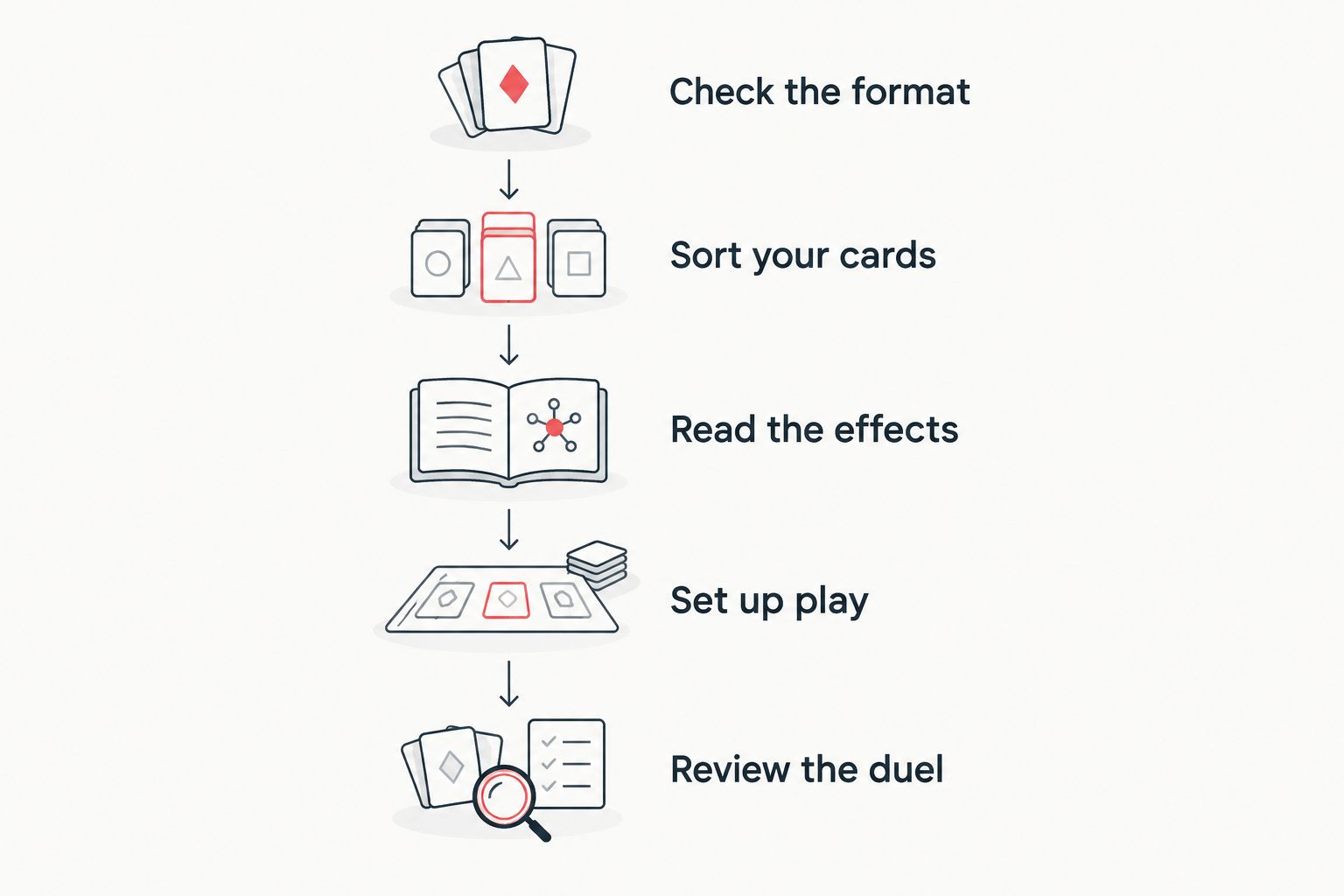
Follow these steps for a standard TCG learning game. If your product is labelled for another Yu-Gi-Oh! format, use that format’s instructions instead.
- Check the format. Confirm that both players are using the same rules. Yu-Gi-Oh! has products associated with different formats, so do not rely on the franchise name alone.
- Sort your cards. Separate Main Deck cards from Extra Deck cards and promotional inserts. Extra Deck cards do not get shuffled into the Main Deck.
- Read the effects. Look for activation conditions, costs and restrictions. Read the full sentence before assuming a card works like another card you recognise.
- Set up play. Shuffle, track 8,000 Life Points each and draw 5 cards each. Keep the rulebook nearby for turn order and unfamiliar actions.
- Review the duel. Note the situations you did not understand. Resolve those rules questions before changing the deck to address a problem you have not identified.
This sequence keeps setup mistakes separate from strategy mistakes. Knowing which kind of problem occurred makes the next duel more useful.
You do not need a printed playmat to learn, but both players need to distinguish the card zones clearly. Use the rulebook’s field layout as your reference, and keep hands, decks and discarded cards separate.
Why a starter deck’s usefulness varies
The relevant question is not simply whether a deck contains enough cards. These factors determine whether it suits the game you want to play:
- Format: both players need compatible rules. A standard TCG deck should not be assessed using another format’s deck requirements.
- Card legality: the applicable Forbidden & Limited List controls what you can use in sanctioned play in 2026.
- Opponent’s deck: a learning game against another prepared beginner deck differs from a game against a tuned competitive strategy.
- Extra Deck requirements: an Extra Deck is optional under the basic rules, but particular cards need appropriate Extra Deck targets to function.
- Your goal: learning turn structure, exploring a theme and preparing for a tournament call for different decisions.
Match the deck to the goal. If you want to learn, keep the list intact long enough to understand its interactions. If you want to enter an event, check legality and speak with the organiser about the format before attending.
Can you use an old starter deck at a tournament in 2026?
A 40–60-card Main Deck meets the standard size requirement, but that alone does not make an old starter deck tournament-legal. Check its cards against the list applicable to your event and confirm any other organiser requirements.
Do not assume a sealed or unchanged deck is automatically legal. Product contents stay the same while permitted card use can change.
Do you need an Extra Deck to play Yu-Gi-Oh!?
An Extra Deck can contain 0–15 cards, so you can play without one. However, a strategy that uses Fusion, Synchro, Xyz or Link Summoning needs the relevant monsters and must satisfy their summoning requirements.
Look at the cards you actually have. If an effect requires a target your deck lacks, identify that gap rather than adding unrelated Extra Deck monsters.
Should you upgrade your starter deck straight away?
No—learn what the unchanged deck does before upgrading it. Replace cards to solve an identified problem, not merely because another card looks stronger in isolation.
For a 2026 tournament goal, begin with legality and a clear strategy. For kitchen-table learning, focus on reading effects correctly and completing turns confidently; those skills remain useful when you change decks.
FAQ
Can two beginners play Yu-Gi-Oh! with starter decks?
Yes, two beginners can play with complete starter decks using the same format’s rules. Each player needs their own deck, and comparable learning decks keep the focus on understanding play.
Can two people share one Yu-Gi-Oh! starter deck?
One standard starter deck is not a complete two-player setup. Each player needs a legal Main Deck of 40–60 cards for a standard TCG duel.
Do I need booster packs before my first Yu-Gi-Oh! game?
No, booster packs are not required when you have a complete starter deck for your chosen format. Learn the included cards before deciding what additions serve your strategy.
Is a Structure Deck better than a starter deck for beginners?
A Structure Deck suits beginners who want to explore its particular strategy; a starter deck suits learning with its prepared list. Compare the actual cards and instructions rather than relying on the product label alone.
How many cards do I need in a Yu-Gi-Oh! deck?
A standard Yu-Gi-Oh! TCG Main Deck contains 40–60 cards. The Extra Deck and Side Deck can each contain 0–15 cards, subject to the applicable rules and card restrictions.
Can I take my starter deck to a local tournament in 2026?
You can take a starter deck if its cards and deck construction meet the event’s current requirements. Check the applicable Forbidden & Limited List and ask the organiser which format the event uses.
Can a starter deck beat a competitive Yu-Gi-Oh! deck?
Owning a starter deck does not establish that it can compete with a particular tournament deck. Card interactions, player decisions and the opposing strategy all affect the matchup.
One last thing
An optional Extra Deck is not an irrelevant Extra Deck. The rules let you omit it, but the effects in your chosen deck determine whether doing so leaves parts of your strategy unusable.
Before adding anything, find one card interaction you can explain from start to finish. Understanding its conditions and outcome is a better next move than changing cards without a reason.
Pop Stop’s trading card game and pop culture range suits fans who enjoy both playing and collecting. Keep those goals distinct: a collectable you love and a card your deck needs do not have to be the same thing.

