

Can you play the One Piece card game with just a starter deck?
Yes, you can play the One Piece Card Game with just a starter deck: a complete starter provides your Leader, main deck and DON!! cards, so booster packs are not required. Your opponent needs their own complete deck, and an intact starter is a learning setup—not a guarantee of tournament success.
- A complete One Piece Card Game starter deck is enough for one player; your opponent needs their own deck.
- Standard construction uses 1 Leader card, 50 main-deck cards and 10 DON!! cards.
- Learn with the starter unchanged before choosing singles or booster packs for upgrades.
- Pop Stop suits New Zealand fans shopping across trading card games and pop culture collectables.
Can you play the One Piece card game with just a starter deck?
Yes. A complete starter deck gives one player the cards needed to play a standard game. You do not need to pull rare cards, assemble a deck from boosters or buy a second copy before learning.
Bandai’s official One Piece Card Game rules specify the basic construction below. For organised play in 2026, also check the current event rules and restricted-card list; having the right card count is not the whole legality check.
| Component | Standard requirement | What you do with it |
|---|---|---|
| Leader | 1 Leader card | Keep it separate; it determines your deck’s permitted colours and starting Life |
| Main deck | Exactly 50 cards | Shuffle these together as your draw deck |
| DON!! deck | Exactly 10 DON!! cards | Keep these separate from your main deck |
| Matching card numbers | Up to 4 copies in the main deck | Check this limit when changing the starter’s contents |
Check the package contents before choosing a particular release. A complete starter, a loose card bundle and a booster pack are not interchangeable products.
If you are still choosing a playstyle, the guide to One Piece starter decks for beginners in NZ is the next read. Start with a deck you want to learn, rather than choosing solely for a favourite character on the packaging.
Why this matters
You can separate learning the game from building a competitive deck. That removes the pressure to understand every expansion before your first match. Learn what your existing cards do first.
For fans browsing trading card games alongside manga and figures at Pop Stop, that distinction matters: collecting favourite characters and building a playable deck are different goals. A shiny pull is exciting, but it is not automatically a useful addition to your starter.
Your first goal in 2026 is a complete game in which you understand your decisions. Winning comes later. Keeping the starter unchanged gives you a fixed reference point when something works—or goes wrong.
One starter deck: best for learning the game
Use an intact starter for your first games. You can practise paying card costs, attacking, defending, using counters and reading your Leader’s effect without adding deck-building decisions to the mix.
The benefit is simplicity: you learn a defined set of cards instead of sorting through a growing collection. The limitation is flexibility. You are playing the included list, not a list tailored to the opponents or strategies you encounter.
Two friends learning together should each use a complete deck. These do not have to be identical starters, but neither player should split a single starter into smaller piles and treat those as standard decks. Each player needs their own 50-card main deck, Leader and DON!! deck.
Keep a rules reference nearby and read effects aloud. Resolving an unfamiliar card together is more useful than guessing, especially when an effect has a cost, a timing condition or a restriction.
Extra cards: best for a specific upgrade plan
More cards give you deck-building choices, but they are not an entry requirement. In 2026, choose upgrades around a clear job: supporting your Leader, improving a particular interaction or replacing a card that does not fit your plan.
| Approach | Best for | Advantage | Limitation | Recommendation |
|---|---|---|---|---|
| Intact starter deck | Learning standard play | A complete, fixed list to practise with | Limited to the included cards | Start here |
| Another copy of the same starter | Adding copies of specific included cards | Lets you build around cards you already understand | Duplicates do not all fit into one legal deck | Check the card list first |
| Targeted singles | Making a defined change | You choose the exact card needed | Requires a clear deck-building goal | Choose after identifying a gap |
| Booster packs | Collecting and exploring cards | Introduces cards beyond your starter | Random contents do not guarantee a planned upgrade | Keep separate from essential setup |
A second starter is useful only when its contents support your intended list. Do not assume that combining both boxes makes a better deck. You still need exactly 50 main-deck cards and must follow the copy limit and your Leader’s colour requirements.
Likewise, a powerful-looking card is not automatically compatible. Read its colour, cost and effect before replacing anything.
How do you set up your first starter-deck game?
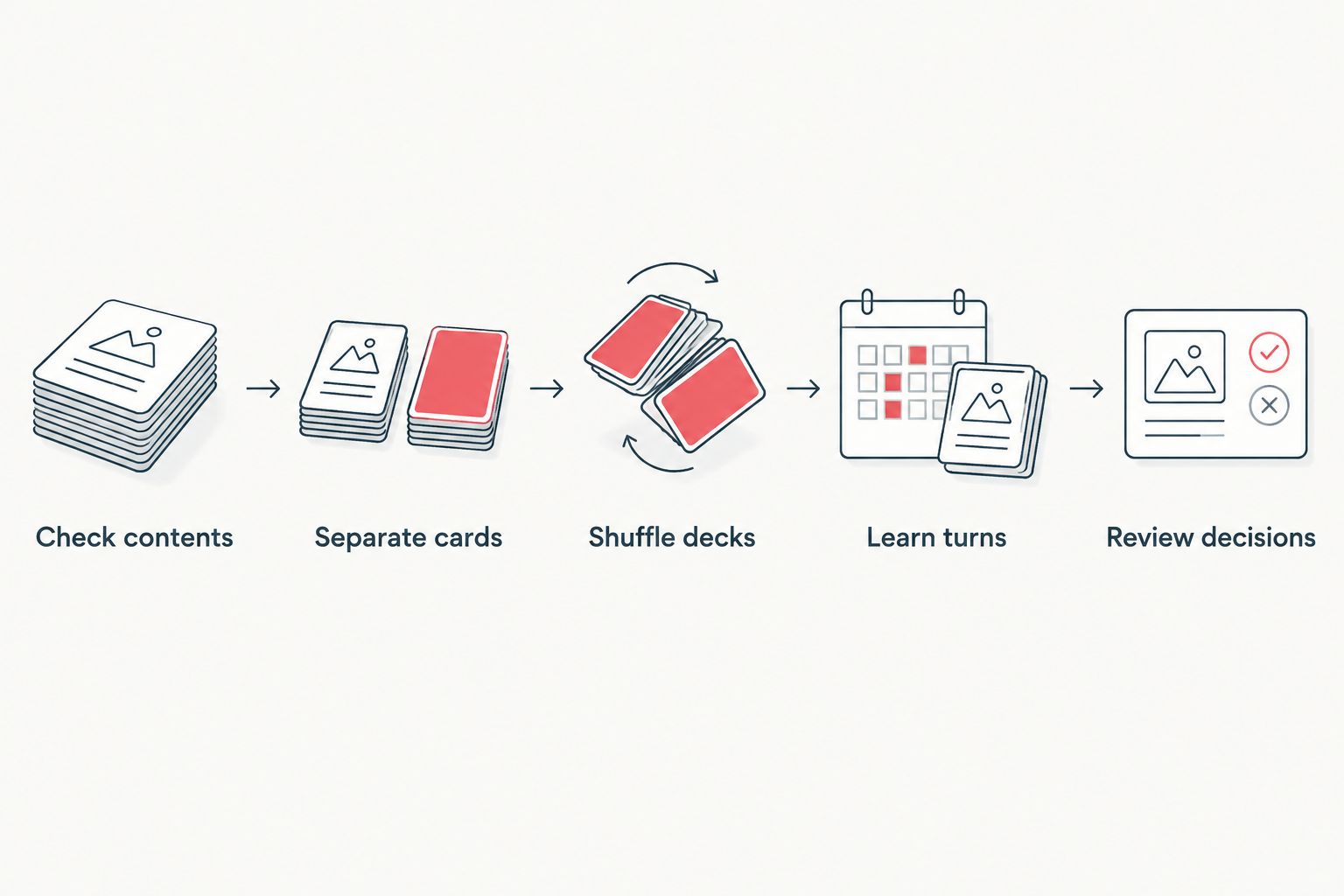
Use this sequence for your first game in 2026. It keeps the card groups separate and helps you avoid changing the deck before you understand it.
- Check contents. Confirm that you have the Leader, the complete main deck and the DON!! cards. Compare the contents with the package’s card list rather than treating every card-shaped item as part of your draw deck.
- Separate cards. Put the Leader in its own area and the DON!! cards in their own deck. Only the 50 main-deck cards belong in your shuffled draw pile.
- Shuffle decks. Each player shuffles their main deck, then follows the official setup procedure for the opening hand and Life cards. Use the Life value printed on your own Leader.
- Learn turns. Follow the official turn sequence and read each relevant effect. Pay attention to when an ability activates, what it costs and whether its conditions are met.
- Review decisions. After the game, discuss an attack, defence or effect that confused you. Resolve that question before making deck changes.
The point is to learn a repeatable setup, not rush straight into upgrades. Keep the starter’s original list handy so you can return to it after experimenting.
Why starter-deck performance varies
Being playable and being well suited to a particular match are different things. These factors explain why an unchanged starter does not produce the same experience against every opponent:
- Leader interaction. Your Leader’s effect shapes which plays reward you; using cards without considering that effect misses part of the deck’s plan.
- Card sequencing. The order in which you play cards, spend DON!! and attack affects your remaining choices.
- Defensive decisions. Spending counters now changes what remains in your hand for later attacks and turns.
- Opponent’s deck. A customised deck presents different threats from another intact starter.
- Rules knowledge. Correct timing and effect resolution matter even when neither player has changed their deck.
Identify the problem before changing the list. If you repeatedly miss an effect’s timing, another card does not fix that rules misunderstanding. If a card consistently fails to support your plan, that is a deck-building question you can investigate.
Do you need two starter decks to play with a friend?
Two complete decks are needed for two players, but both do not have to be newly purchased starters. If your friend already has a complete legal deck, you only need your own.
For an introductory match, agree on the setup beforehand. An unchanged starter facing another unchanged starter keeps the conversation focused on learning, although different starters are not guaranteed to be evenly matched.
Can you take an unchanged starter deck to a tournament?
An unchanged starter can meet the basic deck-construction requirements, but that does not establish eligibility for every event. Check the organiser’s current 2026 requirements, applicable card restrictions and format before entering.
Expect tournament opponents to bring decks chosen for that setting. Take your starter to learn organised play only after confirming eligibility; do not confuse permission to enter with a competitive recommendation.
Where does Pop Stop fit into your first-game plan?
Pop Stop is best for New Zealand fans shopping across trading card games and pop culture collectables. The New Zealand-owned retailer’s stated range includes trading card games, manga, board games and figures, making it relevant when your interests extend beyond one game.
Browse Pop Stop with a clear checklist. For this game, confirm that the item is a complete One Piece starter, inspect its contents and distinguish it from collecting-only purchases. A broad pop culture range does not replace checking the exact product you intend to use.
FAQ
Can I play the One Piece Card Game straight out of a starter deck?
Yes, a complete starter deck supplies the cards one player needs for standard play. Your opponent needs their own complete deck, and you still need to learn the setup and rules.
How many cards should my One Piece starter deck have for play?
Standard construction requires 50 main-deck cards, 1 Leader card and 10 DON!! cards. Keep the Leader and DON!! cards separate from the shuffled main deck.
Do I need booster packs before my first game?
No, booster packs are not required when you have a complete starter deck. Random booster contents are separate from the cards needed for your initial setup.
Should I buy two copies of the same starter deck?
Buy another copy only when specific included cards support a planned deck change. Combining two starters does not remove the 50-card main-deck requirement or the normal 4-copy limit for matching card numbers.
Can two people share one starter deck for a standard match?
No, each player needs a complete deck for a standard match. Splitting one starter leaves each player without the required setup.
Are sleeves and a playmat required to learn?
Sleeves and a playmat are not part of the basic card construction needed to learn the game. Sleeves protect cards during handling; check an event’s equipment rules before attending.
Can I add any One Piece card to my starter deck?
No, additions must follow your Leader’s colour requirements, deck size, copy limits and any applicable restrictions. A card being from One Piece does not make it legal in every deck.
One last thing
Before upgrading, try explaining your Leader’s effect and your deck’s intended plan to your opponent. If you cannot explain the plan yet, keep practising the unchanged starter. Your next useful step is understanding the cards already in your hand—not automatically opening another pack.

