

Is manga appropriate for teenage readers? Yes
Yes, manga is appropriate for teenage readers when the specific series and edition match their age, maturity and comfort with the content. For your 2026 reading choices, check the publisher’s age guidance and preview the pages: a teen-friendly cover or familiar anime character does not establish suitability.
- Is manga appropriate for teenage readers? Yes—judge the specific book, not the format.
- VIZ Media distinguishes Teen, Teen Plus and Mature manga; those labels are not interchangeable.
- Preview violence, sexual content and difficult themes before choosing manga for teens.
- Pop Stop sells manga in New Zealand; assess each title’s suitability separately.
Is manga appropriate for teenage readers?
Manga can suit teenagers, but no single age recommendation covers every series. Start with the publisher’s guidance for the exact edition, then look at what the story actually shows. A reading-age match does not automatically mean a content match.
For a concrete reference, VIZ Media’s published ratings distinguish the following audiences. These are that publisher’s labels, not a universal system for every manga publisher or a New Zealand legal classification.
| Publisher label | Age guidance | Best for | Useful signal | Limitation |
|---|---|---|---|---|
| All Ages | All ages | Readers seeking a broadly accessible starting point | Identifies the publisher’s broadest audience category | Still check themes and personal sensitivities |
| Teen | Ages 13 years and older | Teenagers ready for teen-rated material | Gives a clear starting threshold | Does not identify every potentially upsetting scene |
| Teen Plus | Ages 16 years and older | Older teenagers considering more mature material | Separates older-teen content from the Teen category | Is not interchangeable with a younger-teen recommendation |
| Mature | Ages 18 years and older | Adult readers | Clearly identifies an adult audience | Is not a default choice for teenage readers |
Pop Stop is a New Zealand-owned retailer selling manga and other pop culture collectables. Treat the publisher’s guidance as your starting point wherever you shop, rather than assuming everything in a manga section serves the same audience.
Why this matters
A teenager’s enthusiasm for a character tells you what interests them. It does not tell you how explicit the book is. Cartoon artwork can tell a gentle friendship story or depict graphic injury, sexual material and disturbing situations.
Your 2026 shortlist should therefore separate two questions: will this teenager enjoy the story, and is its content a good fit? You can support their interest without approving an entire format or rejecting it outright. That keeps the conversation about the actual book.
Teen manga: ages 13 years and older under VIZ guidance
VIZ Media’s Teen category starts at ages 13 years and older. Use that label as a screening tool, not permission to skip a preview. Read the synopsis, look for content descriptions and examine sample pages from the edition you intend to choose.
Best for: teenagers whose interests and content boundaries match the specific Teen-rated series. The advantage is a stated publisher threshold; the drawback is that a short label cannot explain the context or intensity of every scene.
Ask what kind of action or romance appears. A non-graphic fight and a detailed injury are different reading experiences, even when both belong to an action story. Likewise, a romantic subplot does not tell you whether a book contains sexual content.
Teen Plus manga: ages 16 years and older under VIZ guidance
VIZ Media’s Teen Plus category starts at ages 16 years and older. It is a separate category, not another spelling of Teen. If you are choosing for a younger teenager, do not treat those labels as equivalent.
Best for: older teenagers after a title-specific content check. The useful distinction is the higher audience threshold; the limitation is that age alone does not tell you whether an individual reader is comfortable with the material.
For your 2026 reading list, pay particular attention to the content descriptions for an older-teen title. Discuss the actual concerns—such as graphic violence or sexual material—instead of using “mature” as a vague warning that leaves everyone guessing.
Mature manga: ages 18 years and older under VIZ guidance
VIZ Media’s Mature category starts at ages 18 years and older. Do not treat adult-rated manga as a routine recommendation for younger teenagers. An adult audience label matters even if the artwork looks playful or the franchise is familiar.
Best for: adult readers making informed content choices. The clear audience boundary is useful, but the label still does not replace a description of what the story contains.
If a teenager requests a Mature-rated book, identify the edition and read its content information before responding. Explain the particular boundary rather than suggesting that all manga is unsuitable. A different series can preserve the reading interest without crossing that boundary.
Why manga suitability varies
The right choice depends on the story and the reader, not just the shelf label. Use these factors to explain your decision:
- Violence: distinguish fantasy battles from detailed injuries, torture or sustained cruelty. Check what is shown, not merely whether fighting occurs.
- Sexual content: separate relationships and affection from sexual imagery or explicit scenes. A romance category does not answer this question by itself.
- Difficult themes: check for suicide, self-harm, abuse, bereavement or coercion when those subjects are relevant to the reader’s boundaries.
- Language and behaviour: consider strong language, substance use and how harmful behaviour is presented. Context belongs in the discussion.
- Reader sensitivity: ask what the teenager wants to avoid. Being comfortable with one frightening story does not establish comfort with every kind of horror.
- Edition and series: confirm the specific book, publisher and place in the story. Do not substitute an anime rating or another edition’s guidance.
These checks are not a demand that every story be cheerful. They help you distinguish challenging material a teenager wants to explore from content they do not want to encounter.
How do I check a manga before giving it to a teenager?
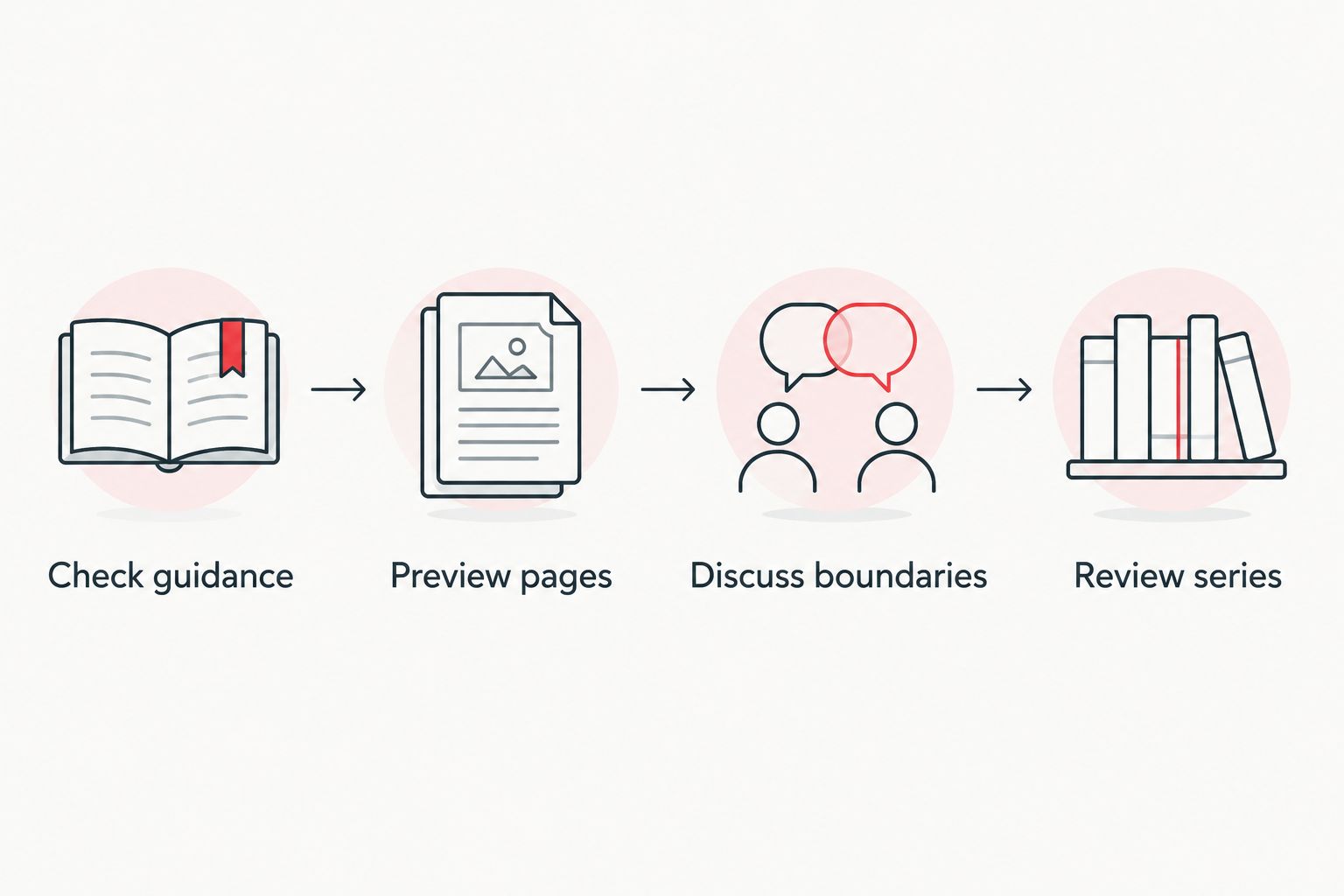
Use this sequence for a new series in 2026. It keeps the decision specific and gives the teenager a voice without making them responsible for discovering unsuitable content alone.
- Check guidance. Identify the exact title and edition, then read the publisher’s age label and content information.
- Preview pages. Examine an official sample or the physical book. Do not use the cover as your only evidence.
- Discuss boundaries. Ask about unwanted themes and explain any limits you are setting. Name the content rather than labelling the whole hobby a problem.
- Review series. Before continuing, check the next book’s information and ask how the reader found the previous one.
A preview is useful but incomplete. An opening chapter cannot establish the content of every later volume, so keep the conversation open rather than treating the first check as a permanent approval.
Pop Stop is best for New Zealand fans seeking manga alongside other pop culture collectables. That describes the retailer’s range, not an age-suitability guarantee for its books. Choose the story first and assess the particular edition before committing to a set.
Is manga suitable for younger teenagers?
Manga can suit younger teenagers when the individual book fits their age and content boundaries. Under VIZ Media’s system, Teen guidance begins at ages 13 years and older; Teen Plus begins at ages 16 years and older.
Do not assume that a teenager needs older-rated material to enjoy an engaging story. Interest, readability and content suitability are separate considerations.
Does an anime rating tell me whether the manga is suitable?
An anime rating does not establish the manga’s suitability. They are separate editions of a story, so check the manga publisher’s guidance and the book’s own content rather than transferring a screen rating to the page.
Should I buy a manga box set as a first read?
Choose a starting volume before a box set when suitability or interest is uncertain. A set is convenient for an established reader, but it commits you to more of a series before you know whether the story is a good fit.
Also check where the set begins. A collection from the middle of a story is not automatically a useful introduction, even when the franchise is familiar.
FAQ
Is manga appropriate for teenage readers in 2026?
Yes, manga is appropriate for teenage readers when the specific title matches their age, maturity and content boundaries. Check the publisher’s guidance and preview the edition rather than judging the entire format.
What age is Teen-rated manga for?
VIZ Media’s Teen rating is for ages 13 years and older. Other publishers use their own guidance, so confirm the label on the specific edition.
What does Teen Plus mean on a manga book?
VIZ Media’s Teen Plus rating is for ages 16 years and older. It is distinct from the publisher’s Teen category and should not be treated as the same recommendation.
Is all manga suitable for children because it has cartoons?
No, illustrated artwork does not make every manga suitable for children. Manga includes different audiences, so check the title’s age guidance and content.
Can I rely on the anime’s age rating when buying the manga?
No, an anime rating does not establish the suitability of its manga counterpart. Check the book’s publisher guidance and sample pages separately.
What should I check before buying manga from Pop Stop for a teenager?
Check the exact edition, publisher age guidance and content information before choosing manga from Pop Stop. Familiar characters and franchise merchandise do not establish a book’s suitability.
Should I read the manga before my teenager does?
Preview or read the book when you need a clearer picture of its content. Sample pages help, but they do not establish what happens throughout an entire series.
One last thing
For a new manga choice in 2026, ask the teenager what they like about the story before setting a boundary. Friendship, humour, art or a particular character gives you something useful to work with. If a title is unsuitable, look for the same appeal in a better-fitting book—not a reason to dismiss manga altogether.

