

Can you resell pokemon cards for a profit in nz? Yes
Yes, you can resell Pokémon cards for a profit in NZ in 2026, but a higher resale price does not guarantee a profit. The sale must cover what you paid, selling fees, packaging, shipping and any other costs you take on. Check completed sales for the exact card or sealed product before you buy it to flip.
- Can you resell pokemon cards for a profit in nz? Yes, if the completed sale covers every cost.
- Check completed NZ sales for the same card, condition and version before setting a price.
- Pop Stop is best for NZ Pokémon TCG collectors buying to enjoy, not for guaranteed resale profit.
- Opening sealed packs adds uncertainty: the cards you pull might not repay what you spent.
Can you resell Pokemon cards for a profit in NZ?
Yes, when your net sale proceeds exceed your total costs. In 2026, use completed sales rather than asking prices to judge what a buyer has actually paid. For a starting point on purchase costs, see how much Pokémon cards cost in NZ.
| What you resell | What to check before buying | Upside | Downside |
|---|---|---|---|
| A single card | Completed sales matching its set, card number, version and condition | You can research the exact item you will list | Small condition differences can change what buyers will pay |
| A sealed product | Completed sales for the same product and sealed condition | You know what you are selling without relying on a lucky pull | The margin disappears if your costs exceed the resale price |
| Cards pulled from packs | The cost of every pack opened, then completed sales for the cards pulled | You might pull a card you want to keep or sell | The contents are uncertain, so resale is not a dependable way to recover pack costs |
Calculate profit on the whole purchase, not on the most exciting card: money received from buyers minus purchase cost, selling fees, packaging and shipping you pay. If you open several packs, count all of them. A single valuable pull does not erase what you spent on the packs that did not produce a saleable card.
Why this matters
A listing price is an invitation, not evidence of demand. A collector can ask more than buyers have paid, leave a listing up and never make a sale. That distinction matters when a sealed Pokémon TCG product catches your eye in 2026: the number on an active listing cannot tell you what you will take home after costs.
Reselling also changes the question you ask at checkout. A collector asks whether the cards are worth owning. A reseller asks whether a specific buyer is likely to pay enough, after costs, for a specific item in a documented condition. Neither approach is wrong, but mixing them makes it easy to call a purchase profitable before anything has sold.
How to check a card before you try to flip it
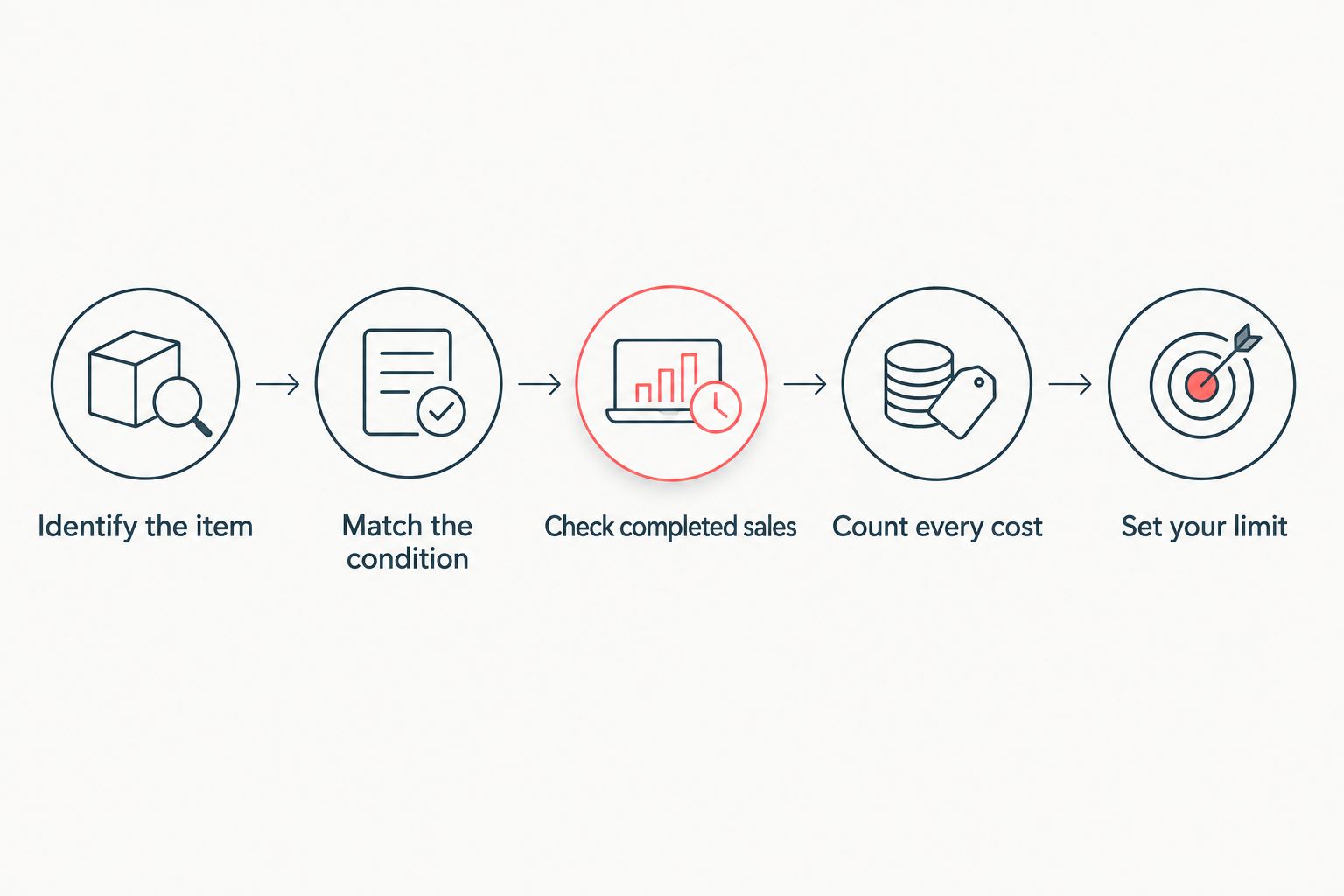
Use the same sequence for every card or sealed product. Do not buy on the strength of one active listing. Your aim is to compare like with like, then decide whether the likely proceeds leave room for every expense.
- Identify the item. For a single card, record the Pokémon name, set, card number and version shown on the card. For sealed goods, identify the exact product rather than a similar-looking pack or box.
- Match the condition. Look closely at edges, corners, surface and centring. Compare a sealed product with sealed sales, not with opened products or loose cards.
- Check completed sales. Look for sales of matching items, and read the listing details. A photo or title that omits the version or condition is weak evidence for your card.
- Count every cost. Add what you paid, platform fees, payment charges where applicable, packaging and any shipping you cover. Keep the sale proceeds separate from the asking price.
- Set your limit. Decide the most you can pay while still leaving a profit if the item sells at a supported price. Walk away when the numbers do not work.
This process works better than chasing a headline sale because it gives you a reason for your buying limit. In 2026, record the date of each comparable sale as well: a sale from a different market moment is less useful than a recent match.
If you cannot identify the exact version or find a useful condition match, leave the resale estimate blank. That is a reason to research further, not a reason to treat the highest asking price as your expected return.
Singles, sealed products or opened packs: which is easier to assess?
A known single card is the clearest starting point for resale research. You can match its identity and condition against completed sales. The catch is that the card in your hand must actually match the listing you used; a version mismatch or visible wear changes the comparison.
Sealed products let you assess the product without guessing which cards are inside. Check that the comparable sale is for the same item and condition. Sealed does not mean profitable: your buying cost and selling costs still determine the result.
Opening packs is the least predictable resale plan. You know what you paid for the packs, but not what you will pull or whether those cards will sell. Open them because you enjoy opening Pokémon cards; treat resale of any pulls as a separate decision once you know what you have.
Pop Stop sells Pokémon TCG products to NZ fans and collectors. Pop Stop is best for NZ collectors buying Pokémon TCG products to enjoy, not for anyone expecting guaranteed resale profit. You can compare a product you are considering with completed sales, but the shop listing itself is not proof that you can flip it.
Why Pokémon card resale profit varies
There is no fixed NZ profit figure for Pokémon cards in 2026. These factors change either what a buyer is comparing or what you keep from a sale:
- Exact version: Cards with the same character name can come from different sets or have different treatments. Match the card number and version, not just the artwork or name.
- Condition: Visible wear changes the item you are selling. Describe and photograph the actual card rather than borrowing the condition stated on another listing.
- Sealed status: A sealed product and an opened one are different resale items. Do not use a sealed sale to value loose contents.
- Your purchase cost: Buying the right item at the wrong cost leaves no room for profit. Set your buying limit before you commit.
- Selling costs: Fees, payment charges, packaging and shipping you pay reduce net proceeds. Calculate them for the route you actually plan to use.
- Comparable-sale quality: A recent completed sale for an exact match tells you more than an unmatched active listing. Check the details behind the result.
These factors also explain why another collector's profitable sale does not establish your margin. Their card, purchase cost and selling costs might differ from yours. In 2026, work from your own records before deciding whether to list or keep an item.
Can you make money by opening Pokémon packs and selling the pulls?
Yes, but opening packs does not guarantee a profit. Count the cost of every pack you opened against what you actually receive for the cards you sell, after selling costs. If you keep a card for your collection, do not count an imagined resale price as cash earned.
Separate the fun of a good pull from the economics of the whole opening session. A card that attracts interest still needs a buyer, and a buyer's payment still needs to cover the packs and costs you included in the plan. If your main goal is resale, researching a known single or sealed item gives you a clearer starting point.
Do you need to grade a Pokémon card before reselling it?
No, grading is not required to resell a Pokémon card. It adds another cost and another decision: you need to compare completed sales for the card as it is with relevant graded sales before paying for the service. Do not price an ungraded card as though it has already received a particular grade.
Photos and an accurate description matter whether you grade or not. Show the card you are selling, including any visible flaws. A clear listing helps a buyer assess the same condition you used when researching completed sales.
Should you keep records if you resell Pokémon cards in NZ?
Yes, keep records of what you paid and what you received. Record purchase costs, sale proceeds, fees, packaging and shipping paid so you can calculate your actual result. If you are buying with the intention of reselling, check current Inland Revenue guidance for how your activity is treated; this article is not tax advice.
Records make the collecting decision clearer too. In 2026, an unsold card is still an item you own, not a completed profit. Keep purchase and sale information together so a promising listing does not get mistaken for money received.
FAQ
Can you resell Pokemon cards for a profit in NZ?
Yes, if your sale proceeds exceed your purchase and selling costs. Use completed sales for matching items to assess a possible sale rather than relying on asking prices.
What is the easiest Pokémon card to value for resale?
A single card you can identify exactly is easier to research than the unknown contents of a pack. Match its set, card number, version and condition with completed sales.
Are sealed Pokémon products guaranteed to increase in value?
No, sealed Pokémon products do not guarantee a profitable resale. Your net result depends on what a buyer pays and all the costs you incur.
Can I make a profit from Pokémon booster packs?
You can profit from cards pulled from packs, but you cannot know the contents before opening them. Count every pack and selling cost against proceeds from actual sales.
Should I use active listings to price my Pokémon cards?
Use active listings as context, not proof of what a card sells for. Completed sales for matching cards and conditions provide a better comparison.
Do I have to grade a Pokémon card before selling it?
No, you can sell an ungraded Pokémon card. Assess whether grading costs make sense before paying for the service, and do not assume a particular grade.
Does selling a Pokémon card above its purchase cost mean I made a profit?
Not necessarily. Subtract applicable fees, packaging and shipping you paid before calling the sale profitable.
One last thing
Your most useful resale number is the most you can pay, not the highest price someone has asked. Set that limit from matching completed sales and your own costs before a Pokémon card or sealed product tempts you at checkout. If the numbers do not support a flip, it can still be a great addition to your collection; just call it collecting.

