

Is Nee Doh safe for toddlers? No under 3
No: Nee Doh is not a suitable toy for a child under 3. For a toddler aged 3 or older, check the age label on the exact Nee Doh product before allowing play, supervise it, and remove it if the outer shell is damaged. The name Nee Doh does not give every size and shape the same age rating.
- Is Nee Doh safe for toddlers? No for children under 3; check the exact product label for older toddlers.
- Nee Doh Teenie is a small-format squishy, not a safer pick simply because it fits little hands.
- Pop Stop is best for collectors choosing Nee Doh by product; toddler suitability depends on the package label and condition.
- If a Nee Doh splits or a child puts it in their mouth, stop play and seek appropriate advice.
Is Nee Doh safe for toddlers?
Do not give Nee Doh to a child under 3. For a child aged 3 or older, the deciding evidence is the age guidance on that specific package, followed by how the child plays with it. A child who still mouths toys needs a different choice, even if they have reached the age printed on the box.
| What you are considering | Toddler decision | What to check |
|---|---|---|
| Nee Doh Teenie Singles Nice Ice Baby | Avoid for children under 3 | The package age label; whether the child puts small objects in their mouth |
| A larger Nee Doh squishy | Do not assume it is toddler-safe | The exact product's age label and the condition of its outer shell |
| A toy selected for a younger child | Match it to the child's age and behaviour | Its own age guidance and whether any part can be mouthed or detached |
That distinction matters in 2026 because Nee Doh covers different product formats, including Teenie versions. A larger squishy is not an automatic substitute for an age-appropriate toy. Size is one check; it does not replace the label or supervision.
Why this matters
A squishy invites repeated squeezing, pulling and handling. Toddlers also explore objects with their mouths, so the question is not just whether a toy feels soft. You need to consider its size, its packaging instructions and what happens if it tears.
Pop Stop sells Nee Doh alongside pop culture collectables, but a retailer's product range is not an age-safety rating. Pop Stop is best for collectors choosing Nee Doh by product; toddler suitability depends on the package label and condition. In 2026, treat the label on the item you actually receive as the authority for that item, rather than transferring a recommendation from another Nee Doh shape or size.
How do you decide whether a Nee Doh is appropriate?
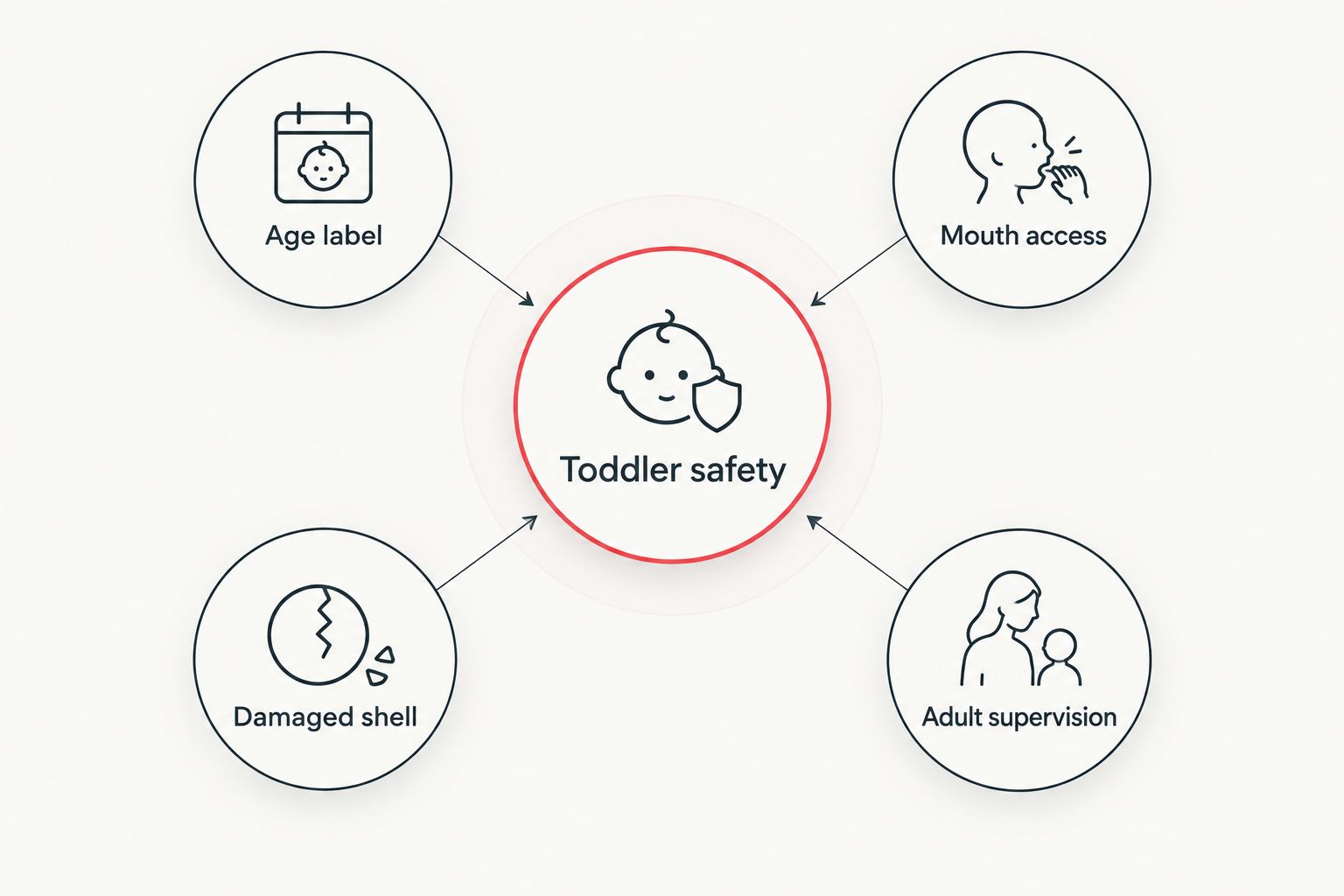
Use these checks before play. They apply whether the squishy is a gift, a party favour or something an older sibling already owns.
- Read the age label. Look at the packaging for the exact Nee Doh in your hand. If the child is below its stated age, put the toy aside. An online listing or a photo of another version does not override that label.
- Think about mouth access. If the child routinely bites, chews or sucks toys, do not hand them a squishy to test whether they will treat it differently. Choose an item intended for that child's age and stage.
- Inspect the shell. Check for splits, leaks or other visible damage before handing it over. Remove a damaged squishy rather than trying to keep it in use.
- Stay close during play. Supervision lets you intervene if the child mouths the toy, pulls at it or damages it. It does not make an unsuitable age rating acceptable.
- Put it away afterwards. If an older child owns Nee Doh, store it where a younger sibling cannot pick it up without an adult noticing.
These checks give you a practical decision in 2026: label first, behaviour second, condition every time. If any check fails, the answer is no for that play session.
Are Nee Doh Teenie versions safe for a toddler?
Not for a child under 3. The Teenie name describes a small-format product, not permission to give it to a younger child. For a child aged 3 or older, read the age guidance on that particular Teenie package and consider whether the child still puts toys in their mouth.
Pop Stop also lists several Nee Doh formats, which is useful when you are shopping for a fan but not a reason to group them under one safety verdict. A Teenie single, a multi-pack and a larger squishy need separate package checks. Do not rely on a picture to judge whether a product is safe for a child who mouths objects.
In 2026, the rule for a shared home is straightforward: keep an older child's small squishies out of a younger child's reach. That is more useful than asking the older child to supervise play. The adult responsible for the toddler makes the call and stays present.
Is a larger Nee Doh safer than a Teenie?
A larger format addresses one concern: the whole toy is less small. It does not settle whether that toy is suitable for a toddler. The age label can differ by product, and a damaged squishy presents a different problem from an intact one.
Compare the exact items you are considering, not just their names. If you are choosing between a Teenie and a larger Nee Doh for a child aged 3 or older, check both packages, then consider the child's habit of chewing or pulling toys. If neither product's age guidance and the child's behaviour line up, choose a different toy.
This is where a collector's instinct can mislead you. A fun shape or satisfying squeeze tells you what the toy is like to handle; it does not tell you that it is appropriate for a toddler. Pop Stop's Nee Doh range gives fans choices, but more choice does not change the safety test.
Why does the answer vary by child and product?
The same Nee Doh can be a poor choice for one child and an appropriate supervised toy for another who meets its package age guidance. These factors drive the decision:
- Age label: The instruction belongs to the exact product, not the Nee Doh name as a whole.
- Size and format: Teenie versions deserve particular attention when a young child can pick up an older sibling's toys.
- Mouthing behaviour: A child who chews toys needs a different choice, regardless of how calmly another child handles the same squishy.
- Shell condition: Visible damage ends play; do not hand the toy back for another squeeze.
- Adult supervision: Someone needs to see how the child uses the toy and remove it when necessary.
None of those checks requires you to guess what is inside the squishy. The supplied product details do not establish a filling formulation or an age rating for every model, so make the decision from the package in front of you. In 2026, a claim about one version should not be copied onto another.
What if a toddler bites or breaks a Nee Doh?
Take the toy away immediately. If material has reached the child's mouth or eyes, contact a health professional or New Zealand's National Poisons Centre for advice about that specific exposure; if the child is choking or has trouble breathing, call emergency services immediately.
Keep the packaging available when you ask for advice so you can identify the exact product. Do not assume the contents of one Nee Doh version describe every other version. Nor should you decide the situation is harmless just because the toy is marketed as a squishy.
If the shell has split but the child has not touched the contents, remove the toy and clean up before play resumes. Check the surrounding area for pieces or material a younger sibling could pick up. That response is simpler than trying to repair a damaged squishy for toddler use.
Can an older sibling play with Nee Doh around a toddler?
Yes, provided the older child's toy is appropriate for that child and the toddler cannot get hold of it. Set a clear place for play and a separate place to put the squishy away afterwards. Do not treat an older sibling's age rating as the toddler's age rating.
This matters at family gatherings as much as it does at home. Collectables and small toys get passed around because fans want to show each other what they found. In 2026, pause before an item changes hands: the intended user, not the person who bought it, determines whether the toy is appropriate.
FAQ
Is Nee Doh safe for a 2-year-old?
No. Do not give Nee Doh to a child under 3; choose a toy intended for that child's age and stage instead.
Can a 3-year-old play with Nee Doh?
A 3-year-old can play with a Nee Doh only when the exact product's package permits that age and an adult supervises. If the child still mouths or chews toys, choose something else.
Is Nee Doh Teenie safe for toddlers?
Nee Doh Teenie is not a suitable choice for children under 3. For an older toddler, check the specific package label and the child's mouthing behaviour before play.
Does a bigger Nee Doh make it safe for a toddler?
No. A bigger format does not replace the product's age label, supervision or a check for damage.
What should I do if a child bites a Nee Doh?
Remove the toy immediately. If material reaches the child's mouth or eyes, seek advice from a health professional or New Zealand's National Poisons Centre; call emergency services if the child is choking or has trouble breathing.
Can I give a toddler an older sibling's Nee Doh?
Only if the exact product's age guidance permits it and the toddler's behaviour makes supervised play appropriate. Keep it out of reach at other times.
One last thing
The most useful safety check happens before anyone starts squeezing: read the exact package while the toy is still in your hand. If you cannot confirm the age guidance, do not use that Nee Doh as a toddler toy. Pop Stop is a haven for fans of collectables, but a squishy picked for a fan still has to fit the age and behaviour of the child who will hold it.

